

The first thing I noticed after several months with the Avantree HT4186 was not the sound. It was that Sal had stopped reaching for the remote. For years he had been nudging the volume up through the mumbled stretches of British mysteries and back down again the moment the theme music swelled, and for years I had been pretending I caught all of it. I am 66, a retired middle-school librarian of 31 years, and I have mild to moderate age-related hearing loss in both ears. I do not wear hearing aids yet. What I wanted was simpler than better hearing. I wanted to watch television in the same room as my husband without turning our family room into a cinema.
I had already tried the obvious things. Subtitles, which I still use, though they spoil a punchline by arriving a half second early. Turning the volume to 42 and watching Sal flinch. A pair of over-ear headphones that clamped my glasses against my temples and left a dent in my hair. What I had not tried was a neckband: a horseshoe of plastic that rests on your shoulders with two small earbuds on short wires. The Avantree HT4186 is that, plus a small transmitter box that plugs into the television. I have used it nearly every night since it arrived, through a full season of a detective series, a great many cooking shows, and every Bills game of the year.
The Quick Verdict
An unglamorous fix that solved the volume argument in this house. The neckband is light enough to forget and the sync is right, but the touch controls took me a week to learn and you must check your television's audio outputs before you order.
Amazon Check Today's Price →The Volume Argument, Settled In One Evening
The HT4186 is two pieces working together: the neckband earbuds and the Audikast-3 transmitter that gets sound out of your television. Check that your set has an optical, AUX or RCA audio output, then look at today's price.
Amazon Check Today's Price on Amazon →How I've Used It
I read the manual cover to cover, which is what 31 years of running a school library does to a person. The Avantree HT4186 is two pieces, not one. There is a small transmitter, the Audikast-3, that plugs into the back of the television, and there is the neckband itself, with the two earbuds on their short wires. I plugged the transmitter into the optical jack on our 50-inch set, turned both pieces on, and had sound in my ears before I finished the second page of the booklet. Our family room is small. The sofa sits about ten feet from the screen, and I had no trouble at that distance.
The first evening was a Tuesday, and I made a small production of it. I unboxed everything on the kitchen table, laid the two cables side by side so I could tell them apart later, and carried the transmitter into the family room with the manual open in one hand. Our low cabinet leaves about four inches of clearance behind the television, which is enough room for a plug and not much else. I had the whole thing running in under ten minutes, which for a woman who once lost an entire afternoon to a printer driver is a genuine compliment to the instructions.
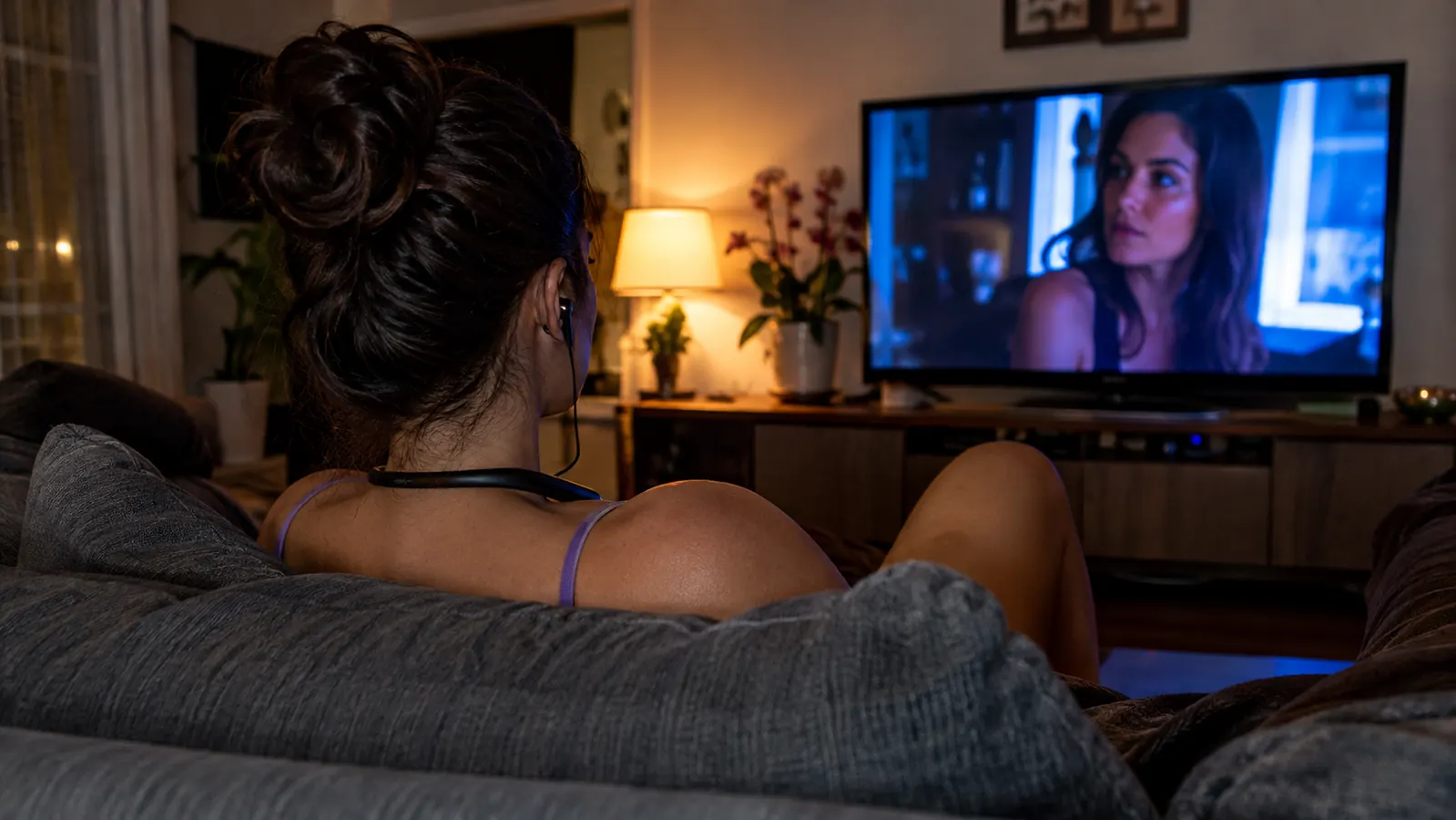
The nightly routine has not changed much, which is the point. Sal settles into the left end of the sofa with the remote, I settle into the right end with the neckband around my shoulders, and the television goes on at a volume a normal-hearing person finds comfortable. He hears it. I hear it. Nobody says pardon. The earbuds sit at the opening of the ear canal rather than over the whole ear, so my reading glasses stay where they belong and my hair does not get flattened.
I keep notes on anything I use for more than a month, so here is what actually changed. I stopped asking Sal to turn it up. I stopped losing whole lines of dialogue when an actor turned away from the camera. And on the nights he falls asleep in his chair, I can watch to the end of an episode without worrying that the gunfire is going to wake him. That last one is not in any listing bullet, but it is the reason I would buy this set again.

Why the Transmitter Decides Whether This Works at All
Most of what you are buying here is the little box, not the earbuds. Bluetooth on its own will not carry television audio well, because your television is not a phone and does not want to be one. The Audikast-3 takes the sound out of the set through a wire and sends it to the neckband. It does that through one of three connections: optical, which is the small square jack usually labeled TOSHLINK and carries a digital signal; AUX, which is the ordinary 3.5mm headphone jack; or RCA, the red and white pair on older sets.
Finding the right jack took a flashlight and a certain amount of kneeling. The ports on our set face the wall, so I sat on the rug with the light angled up and read the labels the way I used to read the fine print on a card catalog drawer. The optical jack is the one that looks like a small square with a notch cut into one corner, and it sits beside a round hole marked AUX and the red and white pair I have not touched since the DVD player went out. Two minutes of kneeling saved me an evening of guessing.
Avantree says plainly to check your television's audio output before you order, and I want to underline that in pencil. Ours has optical, so I was fine. If your set offers only HDMI outputs, this is not the product for you, no matter how good the rest of it is. Fifteen minutes with a flashlight and the back of your television will tell you what you need to know. I would rather you spent that fifteen minutes than a return.
The box includes two Type-C charging cables, one sized for the transmitter and one for the neckband. I keep both in the drawer of the end table, which sounds like a small thing until you have spent an evening hunting for the right cable. In a set like this, the cables are part of the product.
Lip Sync, and a Number Under 50 Milliseconds
Latency is the gap between the picture moving and the sound arriving. It is measured in milliseconds, which are thousandths of a second. When latency is bad, the words land a beat after the mouth stops moving, and your brain spends the whole evening noticing it. Avantree rates the HT4186 at under 50 milliseconds using a Bluetooth codec called aptX Adaptive. A codec is simply a recipe for squeezing audio small enough to travel through the air. Fifty milliseconds is a twentieth of a second.
I am the wrong person to take a manufacturer's number on faith, so I tested it the way anyone can. I found a scene where a character sets a cup down on a table and watched the moment the cup met the wood against the moment I heard it. Then I did it again with a door closing, and once more with a room full of people clapping. Three for three, the sound arrived with the action rather than behind it. That is not laboratory equipment, but it is the test any of us can run in our own living room with a program we know by heart.
In the first week I caught a faint offset maybe twice, and both times it was a scene where I could not have told you what the true timing was anyway. By the second week I had stopped checking. That is the highest compliment I can pay a sync circuit.
One practical note. The earbuds will pair with a phone for music as well, which gives you a second use and a second way to confuse yourself. Twice I switched them over to the radio on my phone and then wondered, out loud, why the television had gone quiet. That is my error rather than the product's, but it is worth knowing before you spend ten minutes diagnosing a problem that is really just a setting.
Twenty-Eight Grams, and a Neckband I Forgot I Was Wearing
The neckband weighs 28 grams, which is just under an ounce. I put it on the kitchen scale to check, because I am that woman. It rests across the back of your neck and on your collarbones, and because the weight sits there rather than on top of your head, it does not interfere with glasses, a hair clip, or the cushion of a chair. I have worn it through a two-hour episode and forgotten it was on, then walked out to the kitchen with it still around my neck, which is exactly the sort of thing a neckband is for.
The earpieces are in-ear, with rounded tips that sit at the opening of the canal. That is a real difference from over-ear cups, and it took me three evenings to get used to the feeling of something in my ear. The fit matters more than the manual admits. If yours sound thin or distant, the seal is usually the culprit, and it is worth adjusting how the tip sits before you decide the set is at fault.
The controls are touch rather than raised buttons, and that is the one part of this set I would change. There is nothing to find with a thumb in the dark, so for about a week I was tapping the wrong place and pausing things by accident. Once my fingers learned the spots, the annoyance disappeared. If you are the sort of person who wants a physical click you can locate blind, budget a little patience for this.
Charging, Cables, and the Sunday Grandchild Problem
Two pieces means two things to charge. Avantree lists a charge time of two hours, and in practice that is roughly what I see when the neckband is low. I plug it in when I go up to bed and it is ready the next evening. The transmitter lives behind the television and rarely needs attention, but it is not a device you can forget entirely. My solution was to put both cables in the same drawer and treat the whole business as one chore instead of two.
One evening in the fourth month I misjudged it. I had been working through a two-part mystery and had not charged the band since the weekend, and somewhere in the second hour the sound simply stopped. The fix took ten seconds with the cable from the drawer, but it cost me the final scene of the episode and a certain amount of dignity. Now I plug it in every night whether it needs it or not, the way I charge my phone, and I have not been caught out since.
Sunday is when our two grandchildren visit, and the family room stops being mine. They watch what they watch, at a volume that would once have sent me out to the kitchen. Now I put the neckband on, or I do not, and either way I can sit with them and follow what is happening. That sounds like a small domestic detail. It is the sort of detail that decides whether a device gets used or ends up in the drawer with the cables.
The warranty runs 24 months, and Avantree covers the cost of return shipping for the first 12 of those if you register the product. Registering took me about five minutes at the kitchen table. I have not needed it, and I would register again, because a two-year term is worth five minutes of paperwork on any piece of electronics.
What I Liked
- Audio arrives in sync with the picture, which was the entire point of buying it
- 28 grams across the shoulders, light enough that I forget it is there by the second scene
- The Audikast-3 transmitter uses the optical output our television already had
- Two Type-C charging cables included, one for each piece, so nothing is missing on day one
- 24-month warranty, and registering covers return shipping in the first year
Where It Falls Short
- Touch controls instead of buttons took me about a week to stop mis-tapping
- Two devices to charge, and a full charge runs about two hours
- Optical, AUX and RCA inputs only, so an HDMI-only television is out
- In-ear tips are a personal fit, and a poor seal makes everything sound thin
The number that sold me was not a driver size or a battery figure. It was the one under 50 milliseconds, because that is the number that decides whether the mouth moves before the words or after them.
Who This Is For
If you are in my position, in your sixties or seventies, with hearing that is fine in a quiet kitchen and unreliable in a room with a television and two other people talking, this set was built for you. It suits a couple where one person hears normally and the other does not, because it lets both of you stay in the same room instead of one of you retreating. It suits anyone who wants the television at a civilized volume and does not want a headband of cups pressing on their glasses for two hours. And it suits a household where the television has an optical, AUX or RCA output and where nobody wants to learn a new operating system to watch the news.
Who Should Skip It
Skip it if your television only offers HDMI output, because the Audikast-3 has no way in. Skip it if you want a single device you never have to charge, since two pieces need two cables and a small routine. Skip it if you want physical buttons you can find without looking, because the touch controls will irritate you for a week and possibly longer. And skip it if what you really need is help following one voice in a crowded restaurant, which is a different problem with a different answer. I am a retired librarian with a library card, not an audiologist, and nothing I have written here replaces a hearing test. If you are cupping a hand behind your ear in restaurants as well as in your own living room, make the appointment first and buy the headphones second.
If The Volume Argument Sounds Familiar
The Avantree HT4186 is not a hearing aid and does not pretend to be one. It is a way to hear your own television at your own volume without moving everyone else out of the room. Check the back of your set first, then look at today's price.
Amazon Check Today's Price on Amazon →