
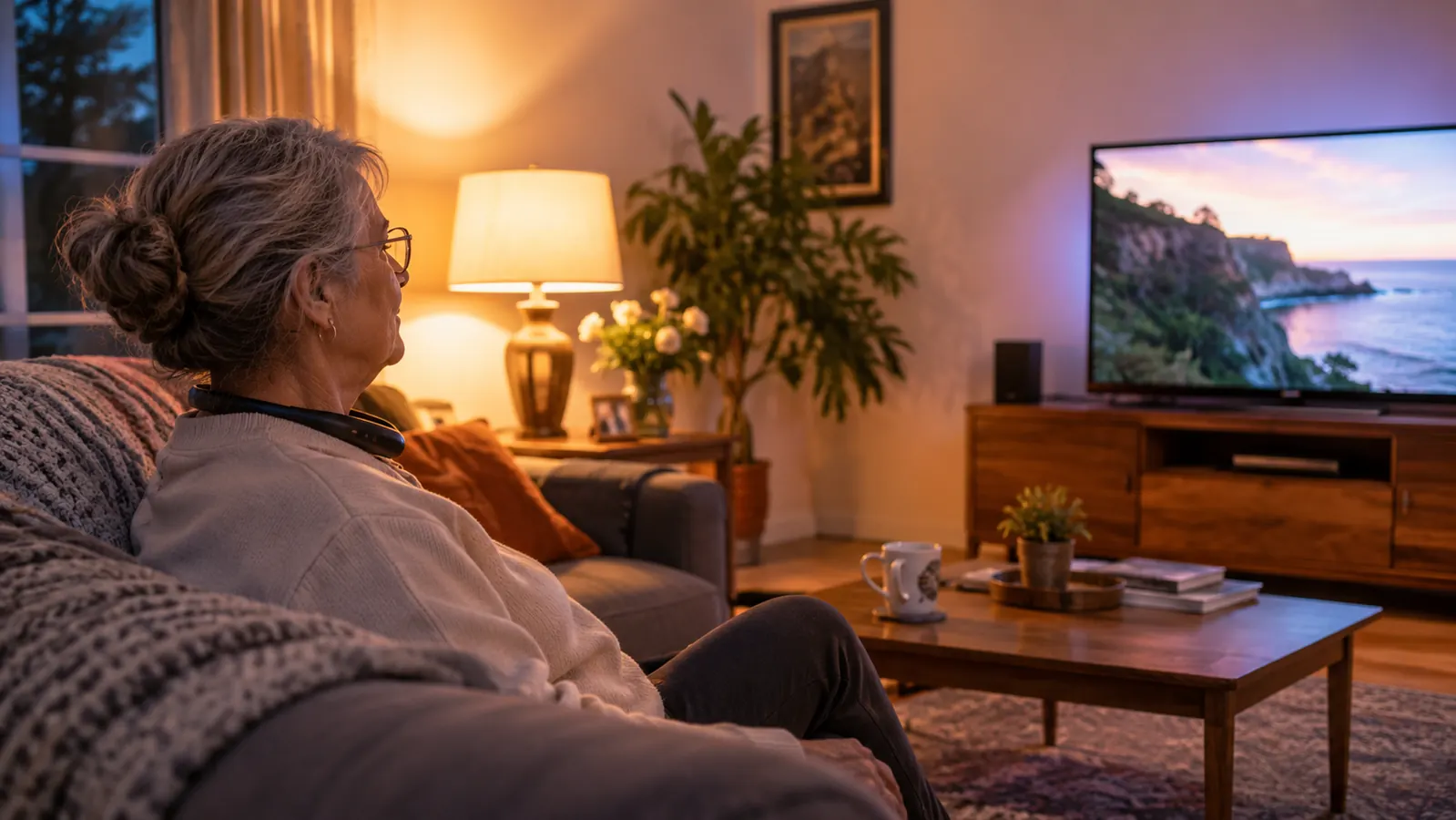
I measured it on a Tuesday afternoon with a tape measure and a bad attitude. Our sofa sits 10 feet from the 50-inch TV in the family room, and after three years of mild to moderate hearing loss, those 10 feet had turned into a nightly negotiation. Sal, my husband, retired mail carrier, hearing perfectly ordinary, had stopped asking me to turn the volume down. He had started leaving the room in the middle of an episode instead, which is a worse review than anything I could write. So I got hold of both kinds of gear that people in my position get pointed toward: the Avantree HT4186, a wireless neckband set that ships with its own transmitter, and a neighbor's over-ear TV headphones, the big-cup kind that charges on a base. I wore each for a week. British mysteries, cooking shows, one very loud Buffalo Bills game.
Here is the short answer, since that is what you came for. If your sofa is about 10 feet from the screen and the room is otherwise quiet, both of these work, and the choice comes down to how you watch rather than which one is better built. The Avantree HT4186 wins on weight, on getting up in the middle of a show, and on doubling as a phone headset. Over-ear TV headphones win on shutting the room out and on the charging habit. Neither one is a mistake. They answer different questions, and only one of those questions is the one my sofa asks.
| Avantree HT4186 | Over-ear TV headphones | |
|---|---|---|
| How it sits | Neckband rests on the collarbone, tips sit in the ear, nothing presses on the outer ear | Cups surround the whole ear, which is exactly why the room goes quiet |
| Weight | Listed at 28 grams | Headband plus two cups, noticeably more on your head by hour three |
| Lip sync | aptX Adaptive over the included transmitter, listed under 50ms | Base-station sets are usually low latency as well |
| Walking to the kitchen | Bluetooth, so it keeps playing as you leave the room, and it pairs to a phone on its own | Usually tied to its base station, so it stays in the room |
| Charging habit | Two Type-C cables in the box, charge time listed at 2 hours | Drops onto the base to charge, so it is always where it lives |
| Controls | Touch controls on the neckband, quiet and flat | Real buttons on the cup, easier to find in the dark |
| Long sessions | Nothing over the ear, so no heat builds up | Cups run warm after a couple of hours |
| Warranty | 24 months listed | Varies by brand, so read it before you buy |
How I Compared Them, Sitting Where You Sit
I did not test these in a lab, and I want to be plain that I am not an audiologist. I am a retired middle-school librarian with a diagnosis and a notebook. My hearing loss is mild to moderate in both ears, three years old, and the thing I lose first is soft dialogue sitting under background music. If you have not had a hearing test, get one before you spend money on headphones. A test tells you what you are working with. A purchase does not.
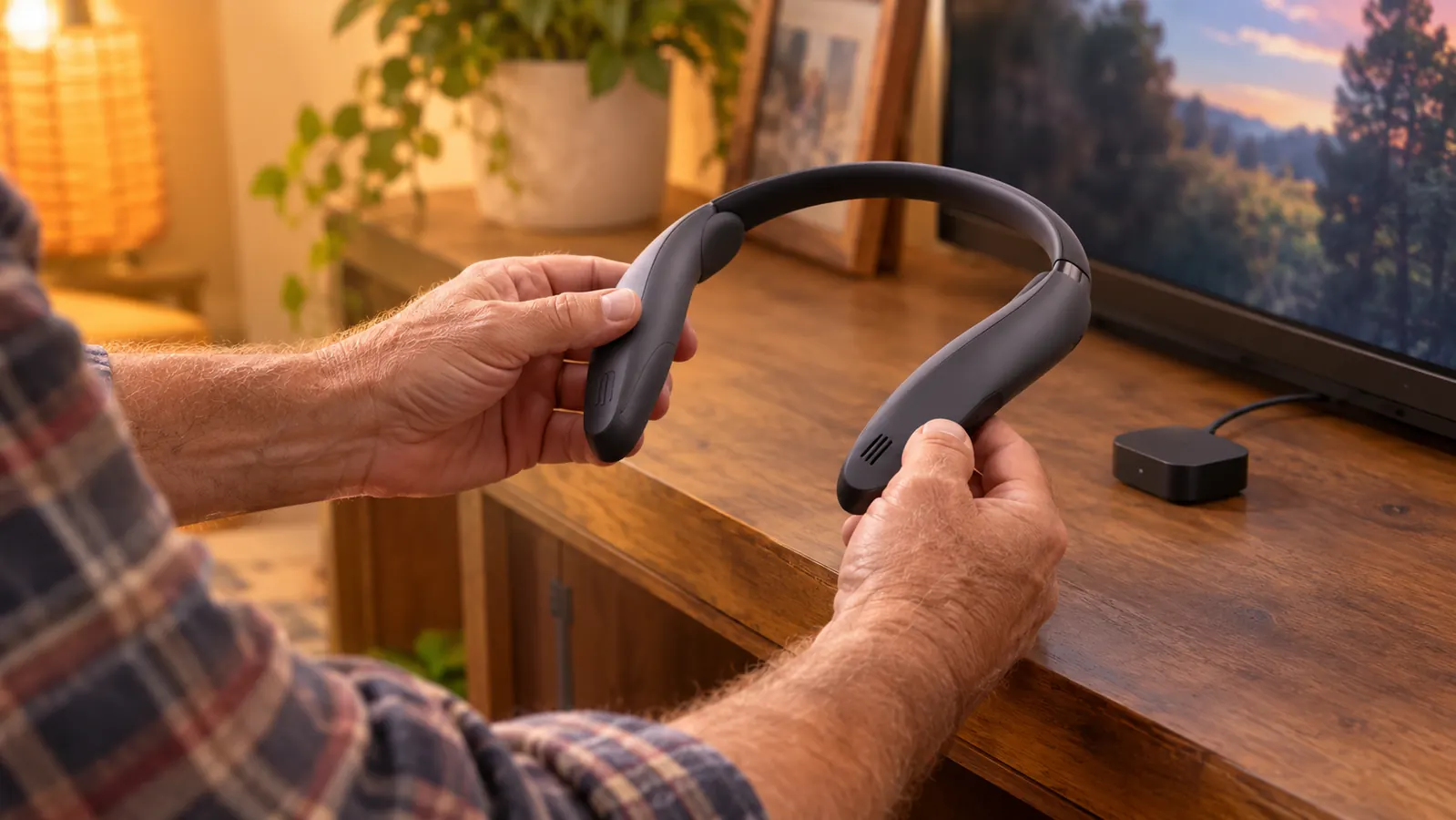
The practical part comes first with any of these. Look at the back of your TV. The Avantree listing says, in its first line, that the set works with TVs that have Optical (TOSLINK), AUX (3.5mm) or RCA audio output, and it means it. Mine has an optical jack, so I ran the cable from it into the small transmitter, which is the Audikast-3 that comes in the box, then set the TV to send audio out through that jack. One evening, one phone call to my son-in-law. The box also includes two Type-C charging cables, one for the transmitter and one for the earbuds, which is the sort of small thing I notice because I have a drawer full of cables that fit nothing.
The over-ear set belonged to a neighbor. Its base station plugs into the TV the same way, optical or RCA depending on the model, and the headphones charge by sitting on that base. That is the entire installation. I swapped the two sets out each evening so the comparison stayed fair: same sofa, same shows, same Sal.
Where the Avantree HT4186 Wins
The listing puts the neckband at 28 grams, and I believe it, because twice in one evening I reached up to check it was still there. Nothing clamps the outer ear. The tips sit in the ear, in-ear and rounded, and the band rests on the collarbone like a lanyard you forgot you put on. By hour three of a mystery, an over-ear cup is a warm, heavy thing, and my reading glasses have left a groove in my temple. By hour three of the neckband I had forgotten the whole question. That is the highest compliment I can pay a piece of equipment.
The second win is movement. I make tea during commercials. I check the oven during cooking shows. The HT4186 is Bluetooth, paired to the Audikast-3 transmitter, and it keeps playing when I walk into the kitchen, because the thing talking to it is the transmitter and not the television itself. The neighbor's over-ear set is tied to its base station by design, and when I left the room it lost the signal and went quiet. The listing also says the earbuds can be used on their own with a phone, and I did that on a Sunday while the grandkids had a cartoon on the big screen that I could happily never see again. Same earbuds, my phone, a podcast at the kitchen table. That is two jobs out of one purchase.
The third win I did not expect. Lip sync. The listing cites aptX Adaptive and a latency under 50 milliseconds, which is jargon for this: the sound and the mouth match. I have watched cheap sets drift a half second behind the picture and it is maddening in a way that ruins a scene. On the HT4186 I did not catch a lag once, including on a live football game where the crowd noise and the play land at the same instant. The precision-engineered 40mm stereo drivers handle a stadium roar and a whispered kitchen conversation in the same episode about as well as anything I have tried at this size. The listed impedance is 32 ohm, which matters a great deal to people who know what to do with that number. I am not one of them.
Sal stopped leaving the room in the middle of an episode. That was the entire test, and the neckband passed it on the second night.
Where Over-Ear TV Headphones Win
I will not pretend the neckband is better at everything, because it is not. If your problem is the room rather than the dialogue, a cup around the ear is the answer. It surrounds you and the dishwasher disappears, the furnace disappears, Sal's phone call in the kitchen disappears. My in-ear tips let all of that straight in. On the night the furnace kicked on during a quiet scene in a British mystery, I missed two lines and had to rewind. That is the honest trade. The neckband keeps you in the room, and there are evenings when what you wanted was out of it.
The other real advantage is the dock. An over-ear set with a base station charges by sitting where it lives, so charging is never a separate chore and never a decision. The HT4186 charges by cable, with the listed charge time at 2 hours. Two Type-C cables come in the box, which helps a great deal, but I still had to build the habit: earbuds on the charger when the credits roll, transmitter plugged in overnight. The first week I forgot twice and watched a mystery through the TV speakers at Sal's volume, which is to say I understood none of it. That is on me rather than the product, but it is a genuine difference in daily life and I would be leaving out the useful part if I skipped it.
Cup buttons are also easier to find by feel in a dark room than a flat touch panel on a neckband, at least for my hands. The touch controls are quiet and modern and they took me several nights to learn. I overshot the volume twice before I got the rhythm of it. If you have ever fumbled for a control during a crucial scene, you know exactly what I am describing.
One transmitter, two Type-C cables, and no more rewinding quiet scenes
The Avantree HT4186 runs from your TV's Optical, AUX or RCA output into the included Audikast-3 transmitter. Latency is listed under 50ms, the neckband weighs 28 grams, and the warranty runs 24 months. It is the set that followed me to the kitchen.
Amazon Check Today's Price on Amazon →
How I Would Set It Up If You Bought It Tonight
Put the transmitter on the cabinet before you open anything else, and find the audio output on the back of the TV. Optical is the small square port with a little shutter that glows red when the set is on. AUX is the round 3.5mm hole, the same size as an old Walkman jack. RCA is the pair of red and white plugs your parents had. The Avantree handles all three, and a cable comes in the box, so check which one your television actually offers before you start moving furniture.
Then go into the TV menu and send the audio out through that jack, and turn the built-in speakers down or off. Charge the earbuds with the Type-C cable while you do the rest, since the listed charge time is 2 hours and there is no sense in rushing it. The transmitter wants a wall outlet as well as the cable to the TV, so clear a small square of space beside the set. Mine sits next to the cable box and nobody has ever noticed it.
After that, the only thing left is the volume, and this is the part that changed my evenings. Once the audio leaves through the transmitter, the room goes quiet and the level lives in your ears. Sal can sit beside me and hear nothing at all, and I can hear every line. For 31 years I ran a school library and settled other people's disputes for a living. It is a relief to have one at home that resolves itself with a cable.
The Details Nobody Puts in the Listing
The transmitter is a small block that has to live near the TV and near a wall outlet. Nobody mentions the outlet. Everybody notices it on day one, especially if the cabinet already holds a cable box and a game console. Budget one more square of space than you think you need.
And I will say this plainly, because it matters more than any comparison table. A neckband is not a hearing aid and I am not your audiologist. Mine is a workaround that happens to suit mild to moderate age-related loss in a quiet room. If your loss is more than mild, if it arrived suddenly, or if it is worse in one ear, headphones are not the answer you are looking for. Get the test first. I did, three years ago, and it is the reason I know what these things can and cannot do for me.
What I Liked
- 28 grams on the neckband, and nothing pressing on the outer ear
- Sound and picture stay matched, listed under 50ms with aptX Adaptive
- Keeps playing when I walk to the kitchen, and pairs to a phone separately
- Two Type-C cables in the box, one for the transmitter and one for the earbuds
- 24-month warranty listed
Where It Falls Short
- In-ear tips let room noise in, including the furnace
- Touch controls took me several nights to learn by feel
- Charge time is listed at 2 hours and there is no dock, so it becomes a habit
- The transmitter needs an outlet and a little cabinet space
- Check your TV has Optical, AUX or RCA output before you buy
Who Should Buy Which
Buy the Avantree HT4186 if your sofa is roughly 10 feet back in a room that is mostly quiet, if you get up during commercials, and if the thought of a cup over your ear for two hours makes you tired before you start. Buy it if you want one set that handles the television and the phone, and if your TV offers an optical, AUX or RCA output so the whole thing is done in a single evening.
Buy over-ear TV headphones instead if the room is loud, if you watch with a dishwasher running and a house full of people, or if you know you will never remember a cable but you will always drop a set on a base. Buy them if your hands want a real button instead of a touch panel. There is nothing wrong with that answer. It is simply a different question than the one my sofa asks, and after a week of both I know which one I am keeping on the cabinet.
Check the back of your TV, then check the neckband
Optical, AUX or RCA output is all it needs. The Avantree HT4186 arrives with the Audikast-3 transmitter and both Type-C cables, so the box is the whole setup. Sal stopped leaving the room on night two.
Amazon See the Current Price on Amazon →