

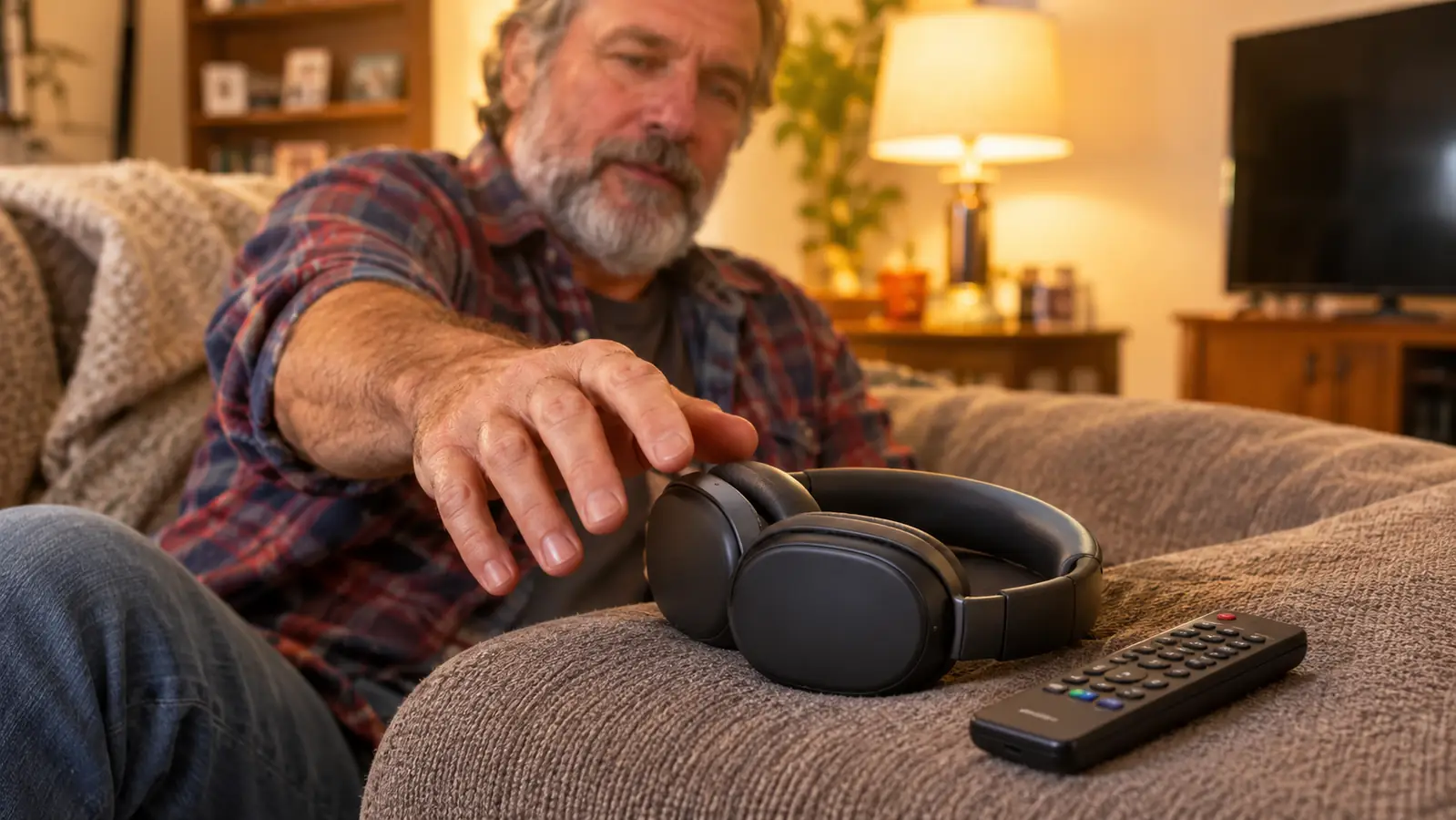
Sal used to wince. That is where this started. It was not the volume itself so much as the guessing: I would push the television up to 38 for a British mystery and then drop it to 22 the moment the commercials arrived, then up again, then down, and he would wince each time the number climbed. Thirty-one years as a middle-school librarian taught me to solve a problem quietly rather than announce it, so I did not tell him I was shopping for headphones for the television. I just did it. That was several months ago, and the Avantree HT5009 has been sitting on the arm of the sofa ever since.
I have mild to moderate age-related hearing loss in both ears, diagnosed three years ago. Fast dialogue and people talking over background music are what I lose first. I am not an audiologist and I will not pretend to be one. If you have never had your hearing tested, close this tab and go do that before you spend anything. But if you have been tested, and the answer came back as mild to moderate loss with no hearing aids yet, then this is the kind of device that fills the gap in the meantime. Here is what several months of nightly use actually looked like in our house in Rochester.
The Quick Verdict
Setup took one evening and no swearing. Clear Dialogue Mode genuinely lifted quiet television dialogue, and pass-through ended the volume argument entirely. The cups run warm after about two hours and the transmitter has no remote, so you walk to it. Neither is a dealbreaker at this level of usefulness.
Amazon Check Today's Price →The volume argument in our house ended on a Tuesday evening
The Avantree HT5009 plugs into the television and works within a few minutes, with no pairing menu to fight. Check the input options for your set and the current price.
Amazon Check Today's Price on Amazon →How I've Used It
Our television is a 50-inch set on a low cabinet, and the sofa sits about ten feet from the screen. That is the entire geography of the problem. Ten feet is close enough to see faces clearly and far enough that quiet dialogue gets swallowed by the room.
From late autumn through the end of the football season I used the HT5009 nearly every night, usually for two hours and sometimes three. I watch British mysteries almost exclusively, the sort where someone murmurs a clue into a cardigan collar while a cello plays underneath, plus cooking shows and Buffalo Bills games when Sal has the remote. So the headphones have been through dialogue-heavy drama, kitchen clatter and crowd noise, which is a decent spread of the things that give me trouble.
Before this set arrived I tried a soundbar, because that is what everyone suggests first. It sat on the low cabinet under the television and it genuinely did make voices clearer, but it made everything clearer, including the commercials and the refrigerator hum drifting in from the kitchen. Sal could hear it out on the porch. I boxed it up after nine days. What I wanted was not louder sound filling the room. I wanted the dialogue delivered to my ears and the room left to its own volume, and those are two different problems with two different answers.
One more piece of context. I read the manual cover to cover before I plugged anything in, which is a habit I cannot shake after three decades of shelving books. It is short, the print is large, and it answered every question I had, including which cable to use. I mention this because the instructions are the part of a product like this that people skip and then quietly blame themselves for.
I also want to be clear about what I am not measuring. I have no decibel meter and no clinical test to show you. What I have is a notebook, a husband with normal hearing who stopped wincing, and a fairly exact memory of how often I used to ask him to repeat things. That is the evidence I can offer, and I think it is the evidence most people in my position actually want.
The Setup: One Cable, One Evening
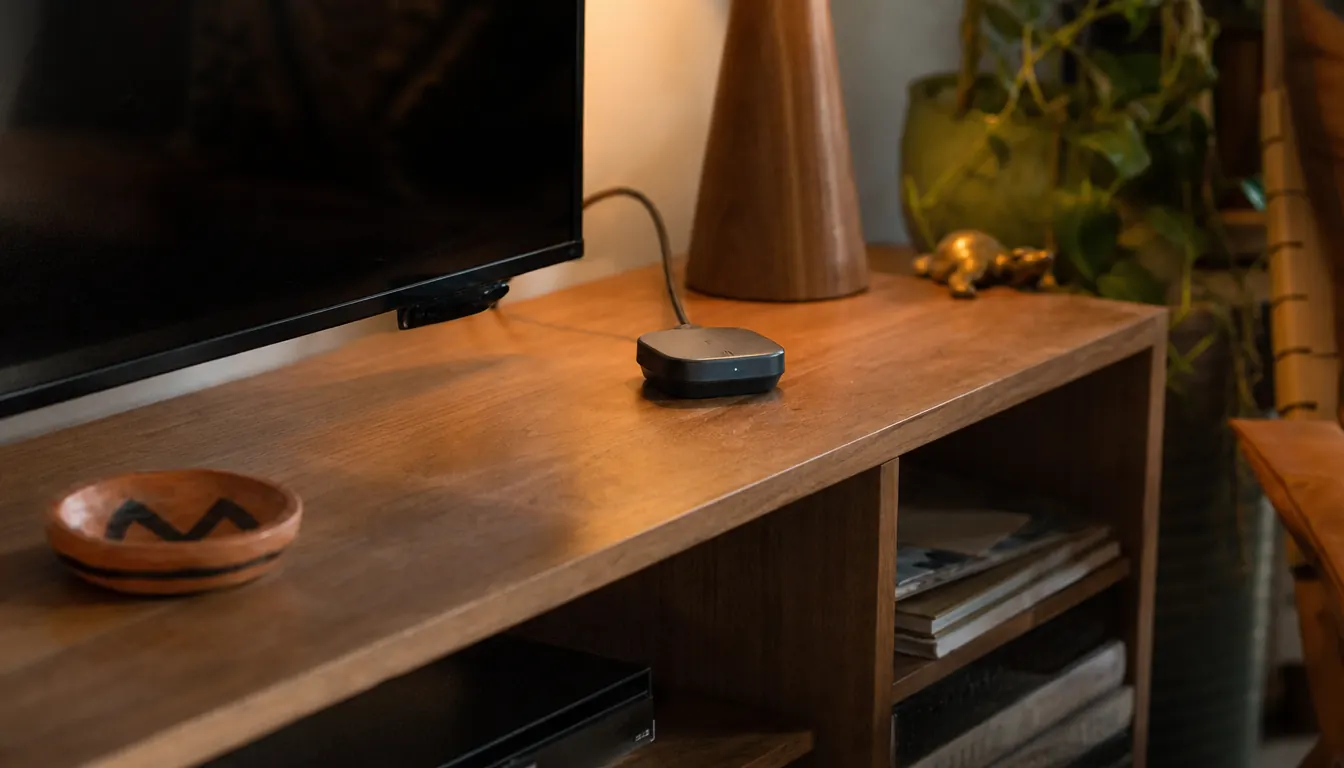
The Avantree HT5009 arrives as two pieces: the headphones and a small transmitter that plugs into the television. According to the listing, the transmitter accepts an optical cable, an AUX cable or RCA cables, and the headphones can also pair directly to a smart television that has Bluetooth built in. Ours has an optical output, so I used the optical cable, and the whole job took about as long as making a pot of tea.
Here is the part I appreciated, because I have fought with Bluetooth pairing before and lost. You do not pair anything. The headphones and the transmitter are already matched to each other, so you plug the transmitter in, switch the television's audio output over to optical, turn the headphones on, and you are done. The first evening I kept waiting for a second step. There was no second step.
The installation itself happened on a Tuesday in late October, the first genuinely cold night of the season, and I remember it because I had to move a stack of cookbooks off the top of the cabinet before I could set anything down. Our television keeps its ports on the back left as you face it, tucked into a recess about the width of my hand, and I needed a flashlight to read the little molded labels. The optical port is the one behind the small square door. With the manual open and a light on it, this took two minutes. Done by feel in a dim room, plan on ten. I plugged the cable in, set the television's own audio menu to optical, and the headphones were already talking to the transmitter before I had finished sitting down.
The one thing worth checking before you order is what your television will give you. A set with an optical output, or one of the newer smart sets with Bluetooth built in, is easy. An older set may need the AUX or RCA cable instead, and that means a cable running from the back of the television to wherever the transmitter sits. Ours lives on top of the low cabinet next to the screen, which keeps it within arm's reach when I need it.
Clear Dialogue Mode and the Mumbling Problem
Clear Dialogue Mode is a setting on the headphones. I want to describe what it did rather than what it claims, so here it is: on a mystery where the detective mutters into his collar while a piano plays underneath, I could follow the muttering without pushing the volume. With the mode off, the piano was louder than the man. With it on, the man came forward and the piano stepped back.
It is not magic and it is not the same as a properly fitted hearing aid. Music-heavy scenes sound a little thin with the mode engaged, so I switch it off for the cooking shows where the sound is mostly clatter and cheerful talking. That is the trade: voices first, atmosphere second. For the kind of television I actually watch, that is the correct trade, and it is the single feature I would miss most if it vanished.
Here is the specific moment I stopped doubting it. We were three episodes into a mystery set in the Hebrides, and there is a scene where two characters stand on a windblown shore and one of them explains the entire motive in a low voice while the sea does its level best to drown him out. On the first pass, with the mode off, I caught perhaps a third of it, and had to ask Sal, who caught all of it without effort. I rewound, switched the mode on, and listened again. I caught the whole thing. I wrote a line in my notebook that night because it seemed worth keeping: the sea stayed loud, the man came forward. That is the whole feature in six words.
The other thing worth naming is lip sync. The listing says no audio delay and I was ready to be disappointed, because every wireless pair I have tried in the past had that awful half-second gap where the mouth moves before the words arrive. I did not get that here. On our set the sound matched the faces, and I stopped thinking about it within a minute, which is the highest compliment I can pay a piece of timing.
With the mode off, the piano was louder than the man. With it on, the man came forward and the piano stepped back.
Forty Hours, 164 Feet and the Rest of the Numbers
The listing puts battery life at 40 hours and wireless range at 164 feet. My honest report on the battery is that I charge it on Sunday mornings and it has never run out mid-program, which after several months of two-hour evenings works out roughly where the number suggests. I have not once had to abandon a show to go hunting for a cable.
Range is the number I expected to be pure marketing. It mostly is not. The kitchen sits just off the family room and I can walk out, refill the kettle, and come back without the audio dropping. If you live in a house with thick plaster walls and a lot of distance between rooms, your result will be worse than mine, because that is how wireless works. But 164 feet is a generous claim for a room that is ten feet wide.
Pass-through support is the feature I did not expect to care about and now would not give up. The transmitter sends the audio along to the television's own speakers as well, so the room is not silenced. Sal can watch the same program at the volume he likes while I listen through the headphones at the volume I need. We are in the same room, watching the same thing, and neither of us is adjusting anything. That is the actual product here, as far as I am concerned. The headphones are simply how it happens.
Comfort, Fit and the Two-Hour Mark
The Avantree HT5009 is an over-ear design, which means the cups sit around the ear rather than pressing on it, and the weight is listed at 196 grams. I notice it for the first minute and then I stop noticing it, which is what you want from something you wear every night. The headband is padded, and it stayed where I put it through an entire episode of anything.
A note on the fit, since that is the thing that decides whether a pair of headphones lives on the arm of the sofa or in a drawer. I found my setting in the first week and have not thought about it since. I wear glasses, and with most headphones the arms of them get pressed into my temples inside an hour, which is usually the moment I give up and reach for a book instead. That did not happen here, and it is the reason these stayed out rather than going back in the box. I tried them one evening with my hair pinned up and one with it down, and the difference was nothing at all, which tells you the fit is doing the work rather than luck.
The honest complaint is warmth. After about two hours my ears are ready for air, and in July I lasted closer to ninety minutes before taking them off during a pause. This is not a flaw specific to this pair. It is what over-ear cups do. In February it was almost a positive, because our family room is drafty and the cups were the warmest part of my evening.
Sal tried them once, out of curiosity, and found the fit snug, though his head is larger than mine and he is not the one who needs them. If someone in your house has a bigger head, that is worth knowing in advance. The controls are buttons on the earcup and they are easy to find by feel in a dark room, which matters more than it sounds when you are halfway through something and do not want to turn on a lamp.
What I Liked
- Plug the transmitter in and it works; no Bluetooth pairing menu at any point
- Clear Dialogue Mode lifted quiet television dialogue without pushing the overall volume
- Pass-through keeps the television's own speakers live, so two people can listen at two volumes
- Forty hours of battery meant a Sunday charge and nothing else
- No audible delay between mouths moving and words arriving
- Over-ear cups stay comfortable for a full episode, and the 24-month warranty is generous
Where It Falls Short
- Ears run warm after about two hours, and in summer that comes sooner
- The transmitter has no remote, so changing anything on it means walking to the cabinet
- Clear Dialogue Mode thins out music and background atmosphere
- Older televisions without optical or Bluetooth will need an AUX or RCA cable run
- Snug fit on a larger head
Who This Is For
This is for the person who has had a hearing test, knows the shape of their loss, and is not ready for hearing aids yet. It is also for the household with one person who has hearing loss and one person who does not, because the pass-through arrangement means neither of you has to give ground. And if your problem is the specific and maddening one of missing quiet dialogue while everyone else in the room hears it perfectly well, the Avantree HT5009 addresses that problem directly and without much ceremony.
Who Should Skip It
Skip it if you have not been tested. I mean that sincerely. Headphones can make television bearable, but they cannot tell you whether what you have is ordinary wear or something a professional should look at, and turning the volume up instead of getting checked is how people lose four extra years. Please make the appointment first.
Skip it too if your television is old enough to offer only RCA outputs and the cabinet sits far from the seating, because the cable run will annoy you every time you look at it. Skip it if you already know you need hearing aids and have been putting off the fitting, since this is a bridge and not a substitute for one. And if you watch alone in a silent house with nobody to argue with about volume, a modest soundbar might suit you just as well and take up less room on the arm of the sofa.
If the wincing at your house sounds familiar, this is where I would start
Months of nightly use in a real family room, with the honest complaints included. Check the input options for your television, then check the current price.
Amazon Check Today's Price on Amazon →