
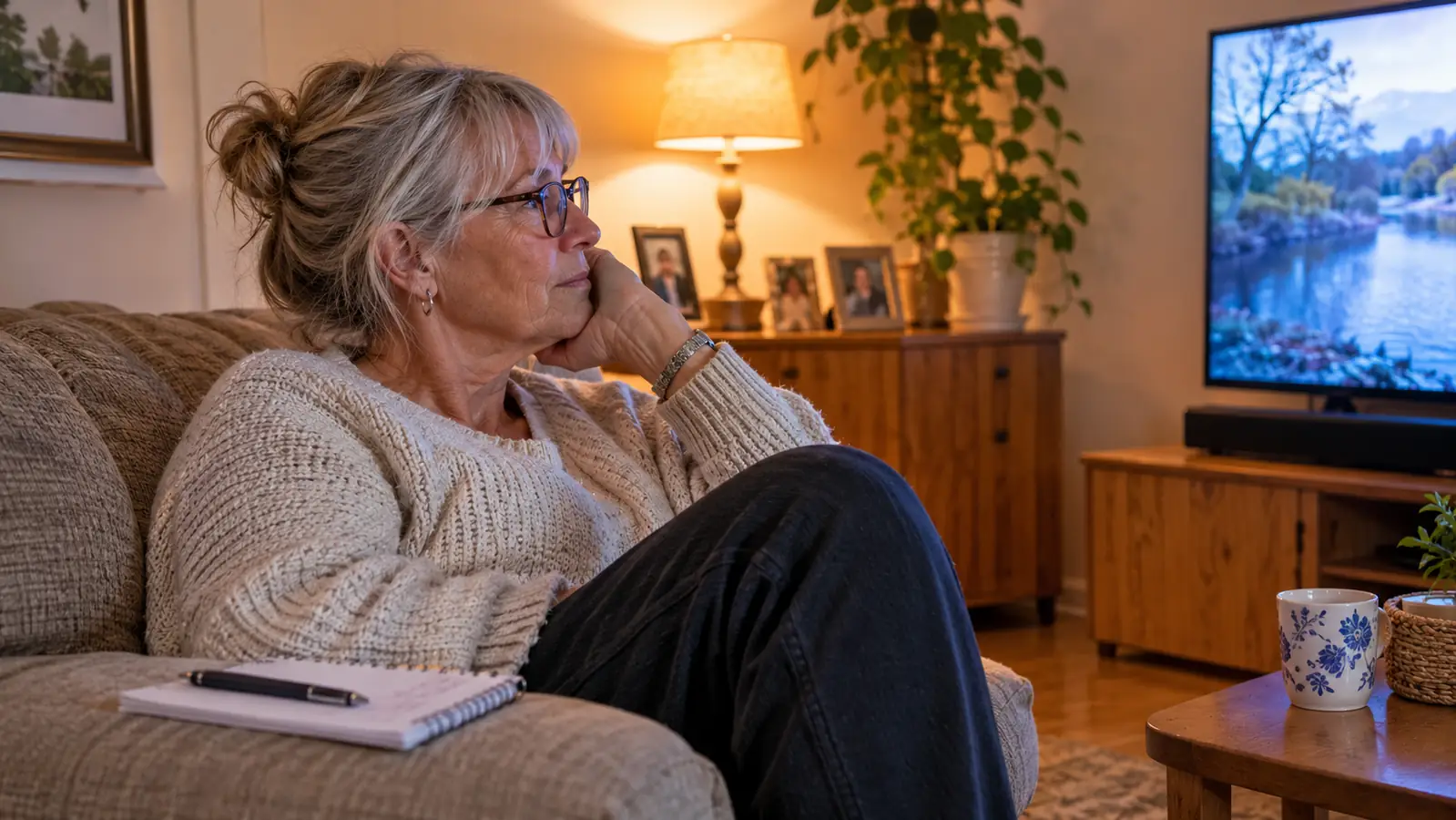
Ten feet is the distance from the front of our sofa to the screen of the 50-inch television in the family room, and that one number decided this entire comparison for me. At ten feet, the speakers built into a flat panel are working much harder than they were ever designed to, and dialogue arrives thin, slightly hollow, and a half step behind the picture. I noticed it first with British mysteries, where half the cast murmurs into a cup of tea and the other half talks over a string section. So I bought the Bose TV Speaker to fix it. Then a neighbor lent me her Sonos Ray for a fortnight, and I set both of them on the same cabinet and took notes the way I took notes for thirty-one years.
Here is the short answer, since I always wanted it first when I was the one reading. For a ten-foot room, mild hearing loss in both ears, and a husband who would rather not learn a new app at sixty-eight, the Bose is the easier piece of equipment to own. One HDMI cable into the ARC port, a remote in the box, no account, no phone, no fuss. The Sonos Ray is the narrower and better-looking of the two, and it is more graceful with music. But nearly everything about it runs through your telephone, and for a listener who is already leaning forward to catch the words, that is a real tax paid every single evening.
| Bose TV Speaker | Sonos Ray | |
|---|---|---|
| Getting it connected | HDMI ARC, optical, or AUX, plus Bluetooth for phones and tablets | Optical cable only |
| Setting it up | One cable, a remote in the box, no app and no account | Optical cable, then the Sonos app on your phone |
| Changing the volume | Its own remote, or the TV remote over HDMI ARC | The app, or teaching it your TV remote during setup |
| Streaming from a phone | Bluetooth, up to three paired devices | No Bluetooth; streaming goes through the app over your home network |
| Clarifying speech | The whole point of the design, and it holds up at low volume | The Speech Enhancement setting does genuine work too |
| Fitting under the screen | 23.38 inches wide and 2.21 inches high, a hair too wide for the gap in my stand | Narrower cabinet that slips between the feet of a low stand |
| Music in the evening | Stereo and pleasant, two angled full-range drivers doing honest work | The more musical of the two, and it shows on albums |
| Hanging it on a wall | Wall mounting is supported | Wall mounting is supported |
Setup Day, One Then the Other
The Bose took me eleven minutes, and eight of those were spent finding a flashlight to see the ports on the back of the television. One HDMI cable from the bar to the ARC port, which is the one port on a modern TV that sends sound out as well as taking picture in. The bar came on, the TV remote raised and lowered the volume without my teaching it anything, and the little remote that ships in the box has been sitting on the side table ever since. No account. No password. No moment where a screen asked me to confirm my email address before it would play the evening news.
The Sonos Ray took closer to twenty-five minutes, and most of that was the app. The Ray connects by optical cable only, which is a perfectly good cable and has been for decades, but it means the bar is not talking to the television in both directions. The app walked me through the rest politely, and it is a well-made app. I still had to go upstairs for my reading glasses to read the small type on my phone, and I still had to create an account for a device that sits four feet from my knees. Sal watched the whole procedure from the doorway and said, and I quote, that this is why he does not buy things that need a password.
Setup matters more than it sounds like it should, because whatever you buy on a Tuesday is what you live with on a Thursday in February when you cannot remember how to fix something. The Bose is a cable and a remote. The Ray is a cable, a phone, an account, and a small ongoing relationship with a company's software. Both are legitimate ways to run a piece of furniture. Only one of them is going to be friendly to a household where the person doing the watching does not consider the telephone to be a control panel.
Where the Bose TV Speaker Wins
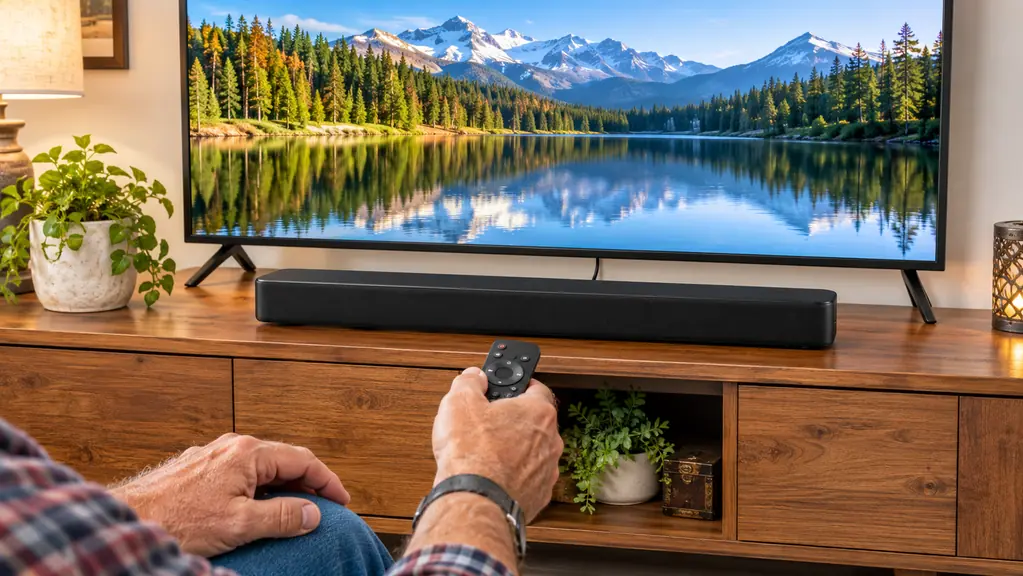
The first win is the one I did not expect to care about: it takes sound from almost anything. HDMI ARC from the television, optical from an older set, an AUX cable if you have something with a headphone jack, and Bluetooth for a phone or a tablet, with up to three devices paired. That last part has turned out to be the quiet pleasure of the whole purchase. On Sunday afternoons I put on a cooking show through the television, and on Tuesday evenings I put on a podcast from my phone without touching the television at all. The Bose is 4.3 pounds and honestly feels heavier than it looks, which I took as a good sign.
The second win is that the television's own remote controls it. This sounds like a small thing and it is not. Over HDMI ARC, the volume buttons on the TV remote move the bar, which means the only remote I have ever needed to learn is the one I already knew. The bar's own remote lives in the drawer now, and the drawer is where remotes go to be forgotten, which is exactly where I want it. There is also a physical button on the bar itself, and I have used it once, on the day I could not find the drawer.
The third win is the speech. The listing says this soundbar clarifies speech, and I have read enough listings to be skeptical of that particular verb, but it held up. The two angled full-range drivers push voices forward of the music instead of burying them in it, and the effect survives when I turn the volume down to something Sal can tolerate at nine at night. That is the test that matters and almost nobody runs it. A bar can sound wonderful at a demonstration volume and turn to mush at the level a household actually watches at. This one does not turn to mush.
By the second episode I had stopped leaning forward. That is the whole review, really, and everything else is bookkeeping.
Where the Sonos Ray Wins
It is the better-looking object, and it is the narrower one. The Bose is 23.38 inches wide, and on my particular cabinet that put its edges a half inch past the gap between the legs of my stand, so it sits on top of the cabinet instead of tucked beneath the screen. The Ray is a shorter cabinet and slipped between the feet with room on either side. If your television is on a low open stand and you want the bar to disappear into the furniture rather than perch on it, that difference is not cosmetic. It is the difference between a tidy room and a room with a black slab on top of the cabinet.
The Ray is also the more musical of the two, and I say that as someone who plays music through a soundbar roughly twice a week and knows she is not the customer the audio engineers had in mind. Albums sound composed on it. Vocals sit in a believable place. The bass is not going to bother the neighbors, but it is not thin either. If the television is secondary in your house and the music is primary, the Ray is the one I would hand you. And if you already have other Sonos speakers around the house, the Ray joins that household in a way the Bose simply cannot, because the Bose is a Bluetooth bar and does not know anything about the rest of your rooms.
The one that let me put the remote down and just watch
One HDMI cable, a remote in the box, and speech that stays clear at nine at night. That is the whole case for the Bose TV Speaker in a ten-foot room.
Amazon Check Today's Price on Amazon →
The Speech Question, Which Is Really the Whole Question
I should say plainly what I am and what I am not. I am a retired middle-school librarian with mild to moderate age-related hearing loss, diagnosed three years ago, and I do not wear prescription hearing aids yet. I am not an audiologist and I am not going to pretend otherwise. If you are turning the television up past the point where the person beside you winces, the first thing worth doing is booking a hearing test, not buying a soundbar. I did the test first and I recommend it without reservation.
That said, a hearing test does not change the physics of a ten-foot room. At that distance, with the speakers buried in the frame of a flat panel and pointing at the back of the screen, the consonants that carry meaning are the first thing to go. Both of these bars address that. The Bose does it as its stated purpose, and does it without any adjustment from me. The Ray does it through a setting in the app, and when I turned that setting on I could hear the improvement clearly. The difference is not that one works and the other does not. The difference is that one of them is the reason the product exists and the other is a toggle I had to go find.
Living With Both for a Fortnight
Sal and I watched four Buffalo Bills games, three mysteries, and a great many cooking shows in those two weeks, and I kept the same list of questions on the pad. Could I hear the announcer over the crowd noise? Yes on both, and comfortably on both. Could I follow a whispered scene without subtitles? Yes on the Bose, mostly on the Ray, and honestly mostly is a fair grade for a soundbar in a room with a hard floor. Did I have to pick up my phone to make an adjustment? Every single time on the Ray, which is the sentence that decided it for me. Not once on the Bose.
The other thing that surprised me was the matter of the second listener. Sal hears well and has spent forty years being the one who says turn it down. With the Bose he stopped saying it, because the sound is clearer rather than louder, and clearer means the volume dial sits lower. With the Ray he also stopped saying it, but I had to hand him my phone twice so he could see the setting I was talking about, and he handed it back the way a man hands back a phone he does not intend to borrow. Small moment. Told me everything.
Who Should Buy Which
Buy the Bose TV Speaker if your room is around ten feet deep, if speech is the thing you lose first, and if you want a device that behaves like a lamp: it is on, it works, you adjust it with the remote you already own. Buy it if there is somebody in the house who will not be installing an app, or if you are the somebody. Buy it if you want to send a podcast from your phone over Bluetooth on a Tuesday night without waking the television up. And buy it if your television stand has a wide open shelf rather than a narrow gap between legs, because 23.38 inches is a real number and it did not fit under mine.
Buy the Sonos Ray if the music matters as much as the picture, if you already live in the Sonos app and find it pleasant rather than tedious, if your stand's opening is narrow, or if you have other Sonos speakers in the house that you want this bar to talk to. Buy it if you are comfortable running your television's sound through a telephone, because that is the arrangement, and it is a perfectly good arrangement for a great many people who are better at phones than I am.
And if you are undecided, do the unglamorous thing I did: measure the distance from your sofa to your screen, then measure the gap in your television stand. Ten feet and a narrow gap points one way. Ten feet and a wide shelf points the other, and both answers are honest. What I would not do is buy either one without first checking your hearing, because no bar on the market fixes a problem that lives inside your ear, and any honest review ought to say so out loud.
For a ten-foot sofa and a husband who winces, this is the one
The Bose TV Speaker: one cable, the remote you already own, and dialogue that stays in front of the music at the volume you actually watch at. I stopped leaning forward in the second episode.
Amazon Check Today's Price on Amazon →