

The first thing I noticed after we moved the speaker was not the sound. It was Sal's shoulders. For about two years he had been flinching every time a car chase started, and I had been leaning forward saying "what did he say?" at the screen, and neither of us had said the obvious thing out loud, which is that we had stopped watching television together. We were watching two different televisions in the same room. I have mild to moderate age-related hearing loss in both ears, diagnosed three years ago. I do not wear hearing aids yet. Sal hears fine, and that combination is harder than it sounds.
What fixed it was not a bigger soundbar and it was not more volume. It was a SEREONIC TV Speaker, a small wireless speaker that sits on a table near your chair instead of across the room under the television. That is the entire idea: shorten the distance between the dialogue and your ear. The unit is 8.8 inches wide, 7 inches tall and 1.7 pounds, so it does not need furniture of its own. It is rated for a 100 foot range, which matters less than you would think, because the right place for it is roughly an arm's length from your head. Everything below is about finding that place in a real room with a sofa, a low cabinet, and a husband who reads the mail at the kitchen counter.
Put the Dialogue an Arm's Length Away
The SEREONIC TV Speaker sits beside your chair, not across the room. Two 5W Class D amplifiers, stereo output, and a 100 foot range so it can move when you do.
Amazon See Today's Price on Amazon →Why the Spot Matters More Than the Volume
Here is the plain version, and I had to have it explained to me twice. When you raise the volume on a television, every sound gets louder at the same rate. The music swells, the explosions swell, and the dialogue swells too, except the dialogue was already the quietest thing in the mix. My ears lose soft consonants first, the t and s and th sounds that carry most of the meaning, so a louder mix mostly delivers louder music. That is how I could follow a cooking show and lose a British mystery inside the same evening.
Moving the speaker changes the arithmetic instead of the volume. Ten feet of room air spreads sound out, and it lets the hard surfaces send a slightly later copy of the same syllable back at you, which is called reverb and which is exactly what makes my kind of hearing loss work so hard. A speaker at arm's length does not have to beat any of that. Most of what you are doing in the five steps below is protecting that short distance.
Step 1: Measure the Ten Feet, Then Pick the Seat
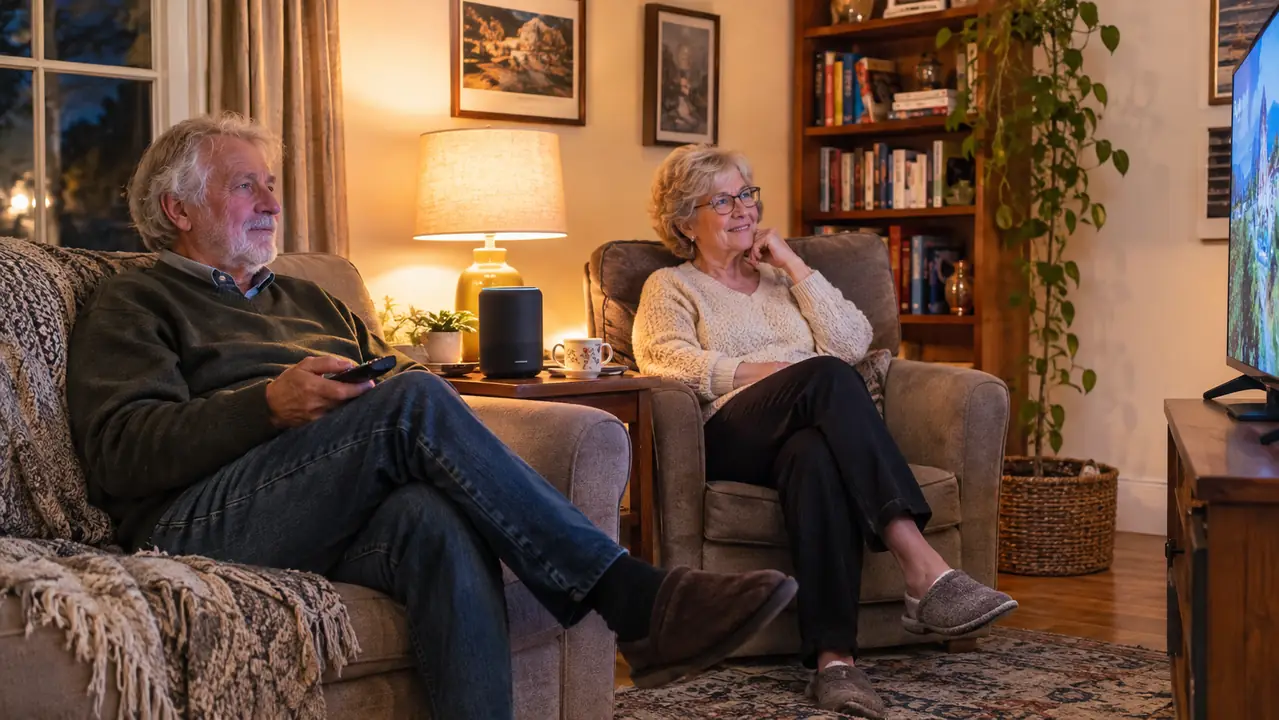
Our sofa sits about ten feet from a 50 inch television on a low cabinet. Ten feet is a normal family room and it is also the number that explains the whole problem. Stand where you actually sit, not where the room looks best, and measure from your ear to the television. Write it on the back of an envelope. In our house it is ten feet from the sofa and about fourteen from Sal's recliner, which is why his chair is the harder one to fix.
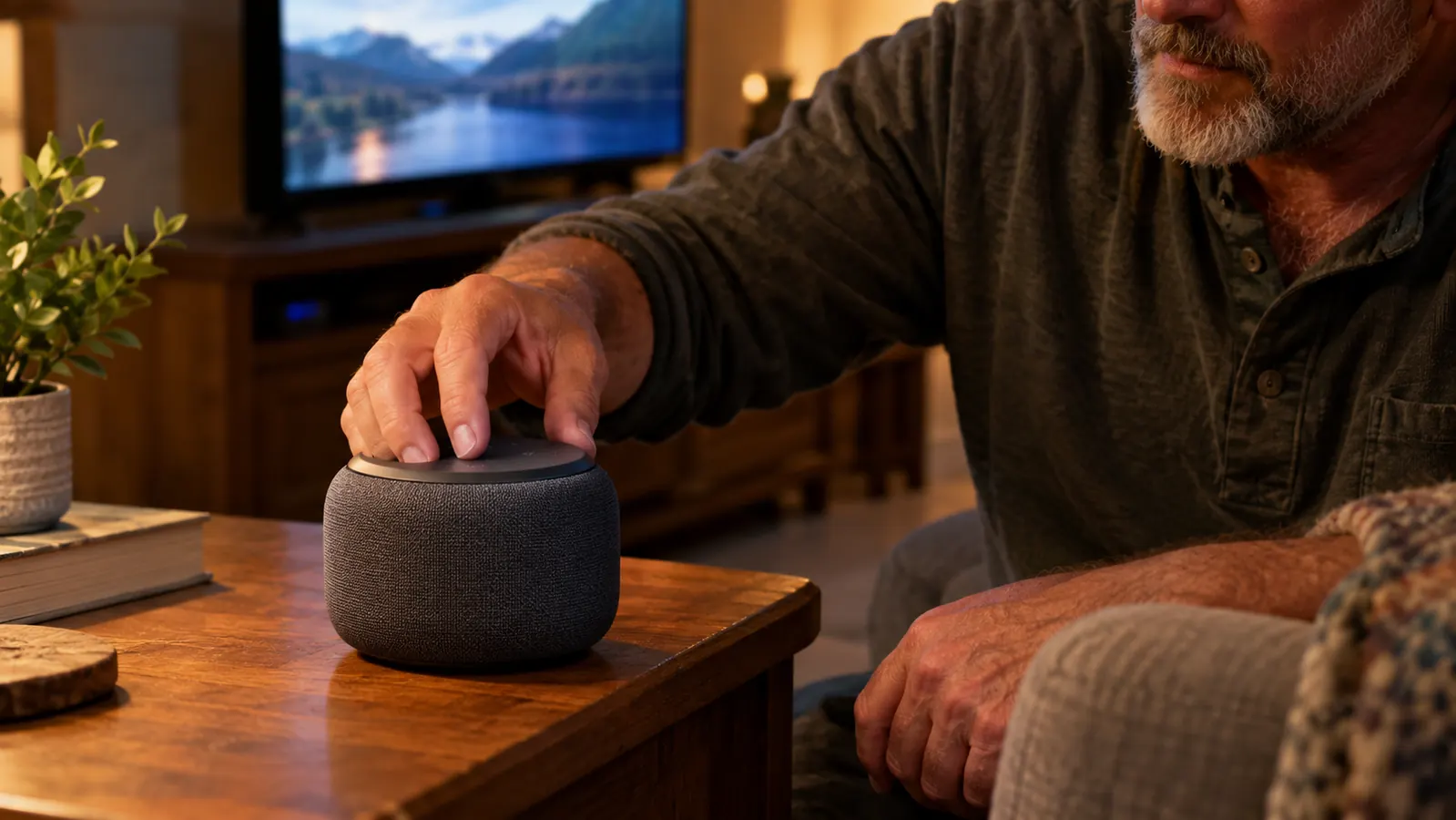
Then look around that seat for a surface. Not the floor, not the TV cabinet, but something at the end of the sofa or beside the recliner. We used a small oak end table that had been holding a lamp, and I moved the lamp to the other side. The speaker is 8.8 inches wide and 7 inches tall, so a side table with a dinner plate's worth of clear space will hold it. If you have nothing there, two hardback books on the floor beside you genuinely work as a temporary measure, and I say that as a librarian with strong feelings about what happens to books used as furniture.
One warning from experience: do not pick the seat first and then try to make the speaker fit it. Pick the surface that gets the speaker closest to your ear, then see whether you can live in that chair. We ended up moving a footstool, not a sofa.
Step 2: Bring It to Ear Height, Just Forward of Your Shoulder
The speaker should end up at roughly the height of your ear when you are sitting down, which for me is a bit above three feet off the floor. Since the unit is 7 inches tall, a standard end table does most of that work already. If yours is low, a sturdy wooden cutting board underneath will lift it without any fuss. This is a tabletop item and nothing gets screwed into anything, so the only tool you need is patience.
Forward, not behind. If the speaker sits behind your shoulder, the sound arrives at the back of your head and your brain spends a moment working out where it came from, which is a moment you do not have when a character is mumbling into a cup of tea. Put it slightly ahead of your ear and angled toward you, and the dialogue arrives first and cleanly. Ours is about six inches forward of my shoulder, angled in maybe twenty degrees. It looks slightly odd from the doorway and sounds completely normal from the sofa.
Keep it out of the direct line between the two of you if you can. Not for acoustic reasons. Just so neither of you spends the evening talking around a small black box.
Step 3: Get It Off the TV Cabinet and Out of the Corner
The obvious place to put a speaker is next to the television. Resist it. The TV cabinet is low, so a speaker sitting on it fires at your knees and the sound still has ten feet to travel before it reaches anyone. Worse, the cabinet usually sits near a wall, and a wall close behind a speaker reinforces the low end, which in a mystery means the cello and the door slams come through beautifully while the quiet parts do not. I tried the cabinet for one evening. Sal said the television sounded like it had a cold.
The same goes for bookshelf corners and the space behind the sofa. Corners collect bass, and bass is not the part I am missing. If you want a simple test, put on a cooking show and walk slowly around the room while someone talks. The spot where the voices sound most like voices, rather than like sound arriving from somewhere, is your spot. For us it was the end table with about two feet of clear space behind it, which is a very unglamorous answer and the correct one.
Ten feet of room was the problem. Six inches of speaker was the fix.
Step 4: Connect It Once, Then Leave the TV Volume Alone
The SEREONIC speaker connects to the television through a small receiver, and the options are RCA, a 3.5 mm aux cable, or a digital input. I used the aux cable because our television has the socket on the side and I could reach it without moving anything heavy. The listing mentions zero audio lag, a phrase I did not believe until we watched a Bills game, where a delayed call is very obvious. There was none.
Set it up once, then stop touching the back of the television. This took me a week to accept. Our old routine was Sal turning the volume up to 40 for me and back down to 22 for himself, all evening, like a very slow argument. Now the television stays around 20, which is comfortable for him, and the speaker carries the dialogue to me. He still gets the room sound. I get the words. Nobody adjusts anything during the good part.
If your television has only a headphone socket, start there. If it has none of these connections, stop and check before you buy anything, because no amount of careful placement fixes a socket that does not exist. I say that as a woman who once bought a cable for a television that had nowhere to put it.
Step 5: Set the Level for the Room, Then Mark the Spot
The controls on the speaker are touch controls, which surprised me. I had expected a knob and got a panel, and the first evening I set the volume far too high out of pure nerves. Start low and raise it while a person on screen is talking, not while music is playing. When the dialogue stops sounding like it is being pushed at you, you are close. Mine sits low in a quiet room and a little higher when the dishwasher is running in the kitchen.
Then mark the spot. I put two small pieces of painter's tape on the end table, one at each front corner, and a pencil line on the shelf beneath it. It sounds fussy and it is fussy, and it means the speaker returns to the right place after dusting instead of drifting two inches a week until the dialogue is aimed at the curtain. The tape has been there since March.
It is battery powered, which is exactly why it can live on an end table with no cable running across the rug, and exactly why it wanders. Twice now it has ended up on the kitchen counter because someone wanted the news while making coffee. The tape marks are how it finds its way back before the evening starts.
What Else Helps
Placement did most of the work, but not all of it. We turned subtitles on and left them on, which I resisted for a year out of pride and now consider basic equipment, like a lamp. We also pulled the sofa about eight inches forward so it is not pressed against the wall, and put a rug down, both of which cut the reflected sound in the room. None of this is medical, and I want to be plain that I am a retired librarian with a small speaker, not an audiologist. If you have not had your hearing tested, go and have it tested. That was the single most useful thing I did three years ago, and it is the reason I can describe what I am losing instead of just feeling vaguely left out of the room.
If you are weighing the SEREONIC TV Speaker against something you wear on your head, those are not really the same purchase, and the tradeoffs are worth reading side by side before you spend anything. Wired headphones gave me more isolation and less togetherness. The speaker gave me the room back. I know which one I would buy again, and I know which one Sal would vote for.
The Best Seat in the Room Is an Arm's Length Away
The SEREONIC TV Speaker runs 2 x 5W Class D in stereo with touch controls and a 100 foot range. It sits on the table beside you and brings the dialogue with it, so the television can stay at a volume everyone else likes.
Amazon See Today's Price on Amazon →