
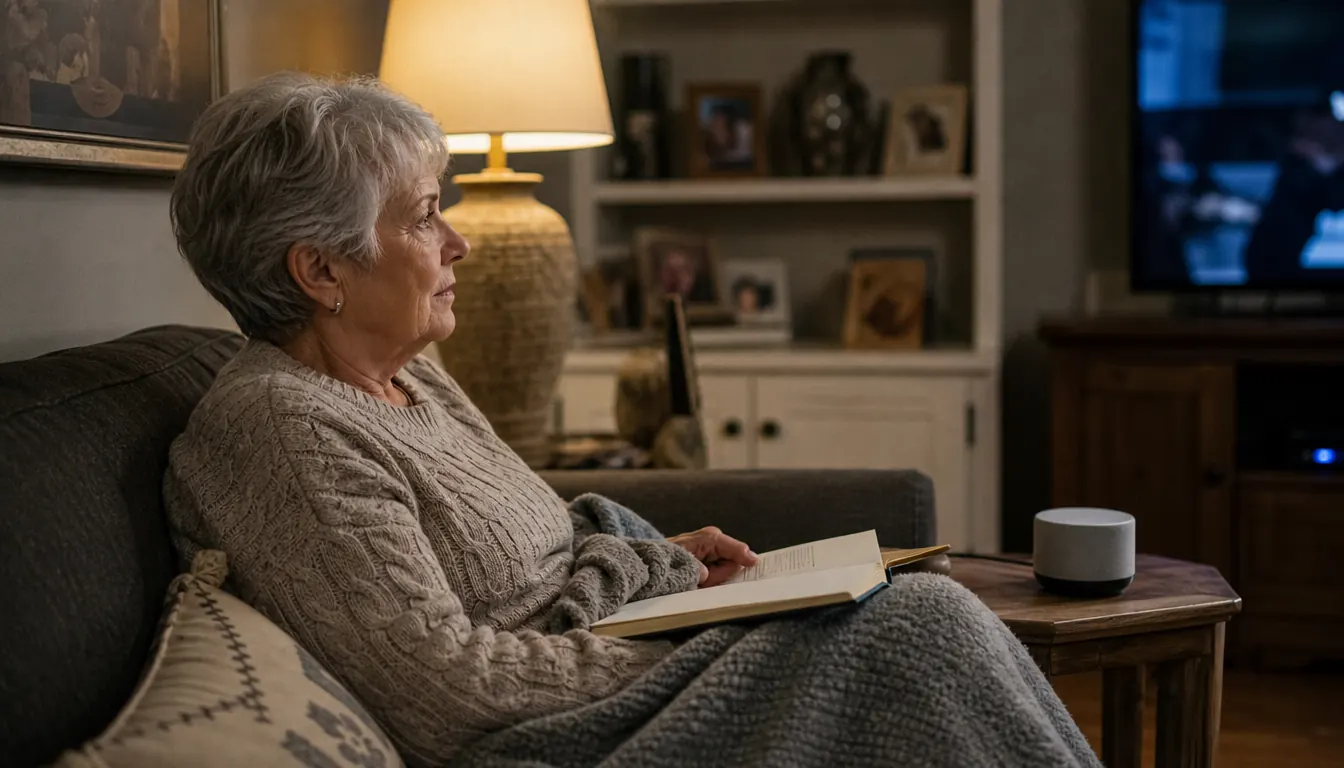
Short answer: on a sofa ten feet from a 50-inch screen, with a husband who hears perfectly well sitting at the other end of it, the SEREONIC TV Speaker is the one I kept. Wired TV headphones solved my problem for two years and I will not pretend otherwise. They just solved it by taking Sal out of the room.
I am Rosalind Ferraro, 66, a retired middle-school librarian in Rochester, New York, where the winters give you plenty of evenings to sit still and listen carefully. Three years ago an audiologist confirmed what I had been blaming on the actors: mild to moderate age-related hearing loss in both ears. Soft voices, fast dialogue, and any scene with music running underneath it are the first things I lose. I do not wear prescription hearing aids yet. I am a woman with a television and a notebook, not a clinician, and what follows is what I noticed in my own family room. If any of it sounds familiar, the useful next step is a proper hearing test, not a shopping page.
The Two Options, Stated Plainly
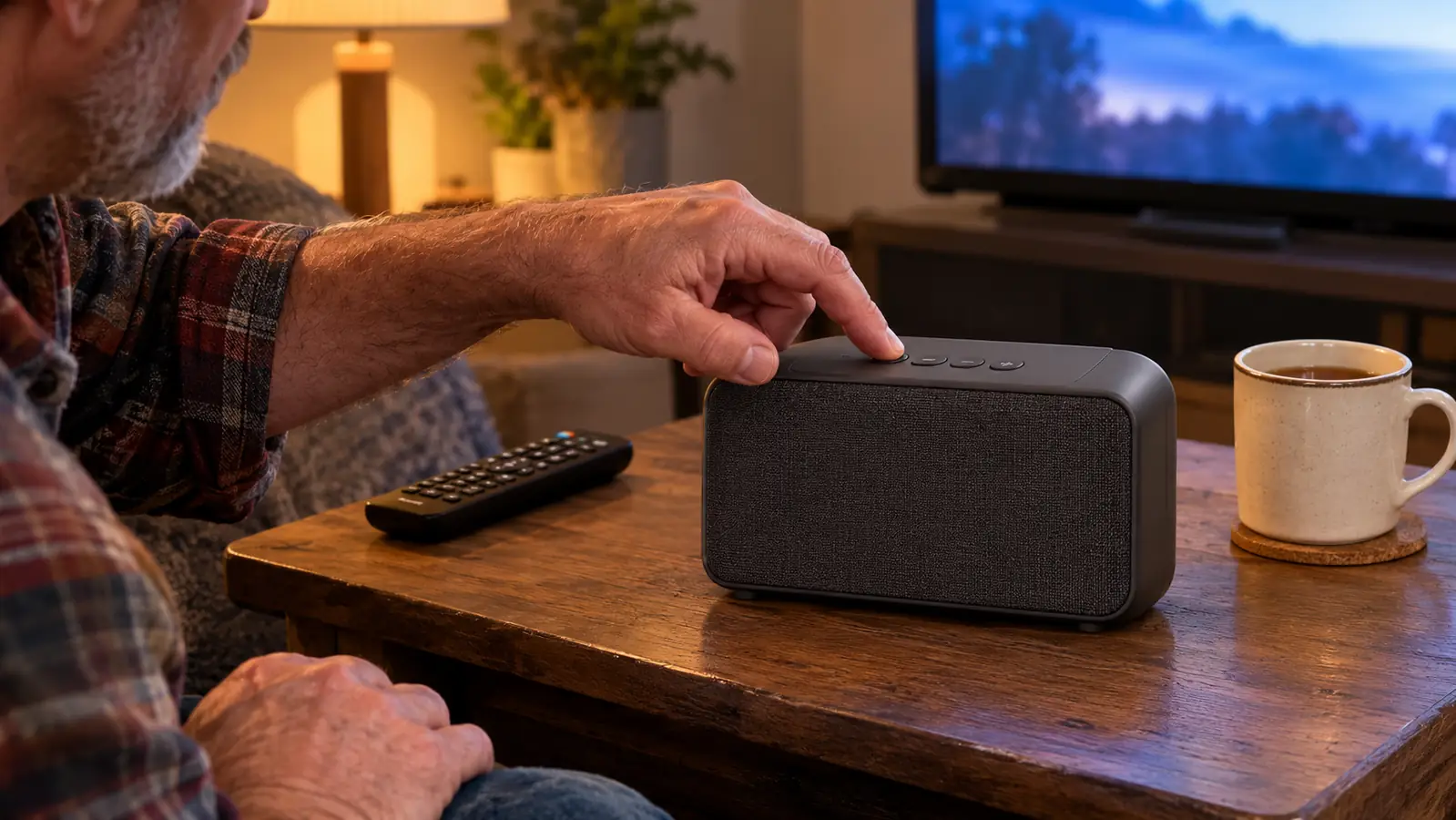
The SEREONIC is a small portable speaker built to sit beside you rather than across the room. A receiver takes the audio out of your television through RCA, a 3.5 mm aux cable, or a digital optical connection, and the speaker itself is wireless, with a range of up to 100 feet. It measures 8.8 inches wide, 7 inches high and 3 inches deep, weighs 1.7 pounds, and mounts on a tabletop. Inside are two 5-watt Class D amplifiers and a 2-inch subwoofer running in stereo, with touch controls on the unit. The listing describes zero audio lag, which matters more than it sounds like it does.
A wired TV headphone is the older answer: one long cable from the television headphone jack to a pair of over-ear cups. There is nothing to pair and nothing to charge. You put them on, the room goes quiet, and the show arrives directly in your ears at whatever level you choose. Two years ago I would have told you that was the end of the conversation.
| SEREONIC TV Speaker | Wired TV Headphones | |
|---|---|---|
| Setup | Receiver takes RCA, 3.5 mm aux or digital optical, then the speaker runs wireless up to 100 ft | One cable from the headphone jack to your ears, nothing to pair or select |
| Late night with a light sleeper in the house | Aimed at your seat, but it is still a speaker filling a room | Nothing leaves your ears, so the hallway stays silent |
| Hearing the rest of the house | The doorbell, the kitchen timer and the person in the next room all come through | Ear cups shut the room out entirely |
| Watching with a second person | Both of you hear the show at the same moment | One pair of ears only, and the other person watches a silent screen |
| Comfort at hour three | Nothing clamped to your head, nothing pressing on your ears | Clamping, warm ears, and a cable tugging whenever you shift |
| Batteries and charging | The controller is battery powered, so it needs keeping fed | No battery to think about, ever |
| Moving around the room | 1.7 pounds on a tabletop with up to 100 ft of range, so it travels with you | You are tethered to the television by the cable |
| Fast dialogue over music | Two 5-watt Class D amps and a 2-inch subwoofer bring voices forward at close range | Straight into the ear, with nothing in the room competing |
| Talking during the show | You can answer a question without reaching for anything | Lift an ear cup and you miss a line |
| Best for | Two people in one room, one of them working harder to hear | One person watching alone after the house is asleep |
How I Compared Them
I gave each one a fair run from the same seat, the one by the lamp, ten feet from the screen. I used the same three programs on purpose: a British mystery where half the plot arrives in a whisper, a cooking show that never stops its background music, and Buffalo Bills games, which are the hardest of the three because the crowd noise simply does not let up.
The notebook stayed simple. Could I follow the dialogue without asking Sal to repeat it? Did I hear the kitchen timer when it went off? Did Sal wince at the volume? At hour three, was I still comfortable? And how long did it take to get from the sofa to actually watching something? I wrote the answers down the same evening, never a week later, because my memory of how something felt is not reliable a week later.
The testing ran through January and into February, which in Rochester means you are not tempted to go outside instead. I started with the headphones on a Monday night, because they were already on the shelf and habit is a stubborn thing, and I wore them for four evenings running before I switched. The first speaker evening was a Thursday, and I remember it because Sal said something to me from the kitchen during the opening credits and I answered him without taking anything off my head. That had not happened in two years. I wrote it down that night, underlined, which tells you how much I expected to be impressed.
I never needed the television louder. I needed it closer. Those are two different problems and they have two different fixes.
Where SEREONIC Wins
The first thing the SEREONIC gave back to me was the room itself. With headphones on, I was watching television in a small private room that happened to be attached to my family room. I could not hear Sal laughing at something in the kitchen, or the timer, or a grandchild coming up the steps on a Sunday afternoon. The speaker sits on the end table aimed at my seat and the rest of the house still exists. That sounds like a small thing. Over a winter it became the reason I stopped reaching for the headphones.
It took me three tries to find the right spot for it, and I will save you the same three tries. On the low cabinet under the television it was better than the set's own speakers but not by enough, because it was still ten feet away. On the coffee table it sat too close to the screen and I kept reaching over it for the remote. What finally worked was the end table by the lamp, angled slightly toward my shoulder, which put it about two feet from where I sit. At 8.8 inches wide it does not crowd the lamp, the mug, or the paperback I am usually pretending to read.
The second thing is that Sal and I watch together again. This is the part I did not expect. The speaker is close enough that I hear dialogue comfortably while the television itself sits where Sal likes it, several notches below where I used to need it. He hears everything. I hear everything. Nobody is shouting over the top of a scene to ask what the Inspector just said. The wireless range of up to 100 feet means the speaker and I are not chained to one spot either.
The third is plain comfort. Nothing is clamped to my head for three hours, nothing presses on my ears, and there is no cable running across the rug for a visitor to catch a foot on. At 1.7 pounds the unit moves easily, so I carry it into the small kitchen during halftime, set it on the counter, and keep listening while I refill the glasses. The touch controls on top are easy to find without looking, which matters when the lamps are low and the program is already running.

Where Wired TV Headphones Win
Now the honest part. If Sal is asleep and I am watching a mystery at eleven at night, the headphones are better and it is not close. Wired headphones put all of the sound in my ears and none of it in the hallway. The SEREONIC is a speaker. It brings the sound close and it does that well, but close is not the same as sealed. If your real concern is a thin wall and a husband who wakes at the click of a light switch, the cable is still the quietest answer in the house.
Second, headphones have no battery to think about. You plug them in and they work, without a routine. The SEREONIC controller is battery powered, which means one more thing in this house that has to be kept fed and one more thing to check before a two-hour program begins. I keep spares in the drawer under the lamp and I still get caught out occasionally. That is a small annoyance repeated often, which is how small annoyances turn into opinions.
There is also the matter of the cable itself, which I did not think about until it started catching on the arm of the sofa every time I shifted. Mine reached from the television to my seat with a few feet of slack, which is enough until you want to set down a cup of tea. Twice I pulled the cups half off my ears reaching for something on the side table, and once, memorably, I took a notebook to the floor with me. None of that is a reason to avoid headphones. It is a reason to know what you are choosing.
Third, headphones ask nothing of you. No pairing, no input to select, no placement to reconsider when you move to a different chair. For a guest, a housesitter, or anyone who does not want a routine in their evening, one cable into one jack is the most forgiving listening setup there is. My speaker setup took a pleasant half hour with the manual and a pencil. A headphone cable takes about eight seconds.
Bring the dialogue to your end of the sofa, not the whole street
The SEREONIC sits on the end table, takes RCA, aux or digital optical from your television, and reaches up to 100 ft. Check the current price and the input list before you order.
Amazon Check Today's Price on Amazon →What Ten Feet Actually Changes
Distance is the whole argument, so it deserves its own section. My sofa is about ten feet from the screen. That is far enough that television speakers firing forward from a low cabinet are asking a great deal of a 66-year-old pair of ears. The dialogue arrives already thin and the music sits on top of it like a lid. Bringing a speaker to within two feet of my shoulder changes that arithmetic without touching the volume dial, and I have not needed the television above Sal's comfort level since.
I measured it because I did not believe my own impression. Ten feet from lens to cushion, a 50-inch screen, and the television speakers sitting maybe eighteen inches off the floor inside the cabinet. Sound coming out at that height, from that distance, is arriving at my ears after crossing the room and bouncing off a wall, and the consonants go first. That is why the mystery is the hardest test and why the cooking show is not: a cooking show is loud and declarative and could be heard from the driveway. The Inspector murmurs. He turns away from the camera and murmurs, and ten feet of air is enough to lose him entirely.
That is the difference between these two options in one sentence. Headphones shorten the distance to zero and take you out of the room while they do it. A speaker shortens it to arm's length and leaves you sitting in your own family room with your own husband. Which one you want depends entirely on whether you are usually watching alone or usually watching beside somebody.
Who Should Buy Which
Buy the SEREONIC if there are two of you on the sofa and only one of you is working hard to hear. Buy it if you are tired of wearing something on your head for three hours, if you want the doorbell and the timer and the person in the kitchen to still reach you, or if you like to carry your listening into the next room during commercials. Buy it if your television has RCA, aux or digital optical outputs, which most sets from the last decade do. Check that one detail before you order, because it is the only thing about this setup that cannot be worked around.
Stay with wired headphones if you watch alone after everyone else is asleep, if there is a bedroom on the other side of the wall, or if you want a setup with no batteries and no pairing and no manual to read. There is no shame in it. For two years it was the right answer for me, and the only reason it stopped being right was that I got tired of watching television by myself in a room with another person sitting in it.
The seat by the lamp is still the best one in the house
If you want to keep that seat and still hear the Inspector, the SEREONIC does the job from the end table. Read the input list, check the range, and see what other people with hearing loss say about it.
Amazon See the SEREONIC TV Speaker on Amazon →