
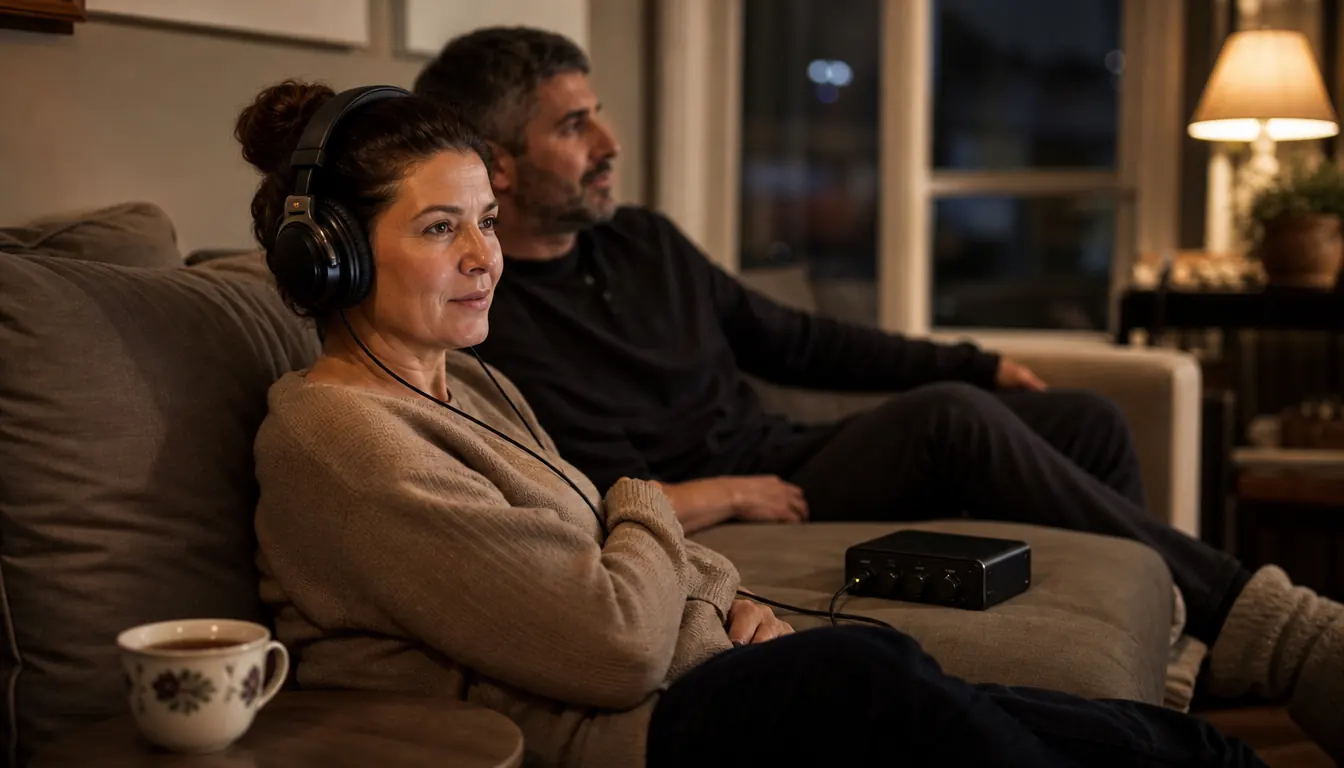
The first thing I noticed was Sal's shoulders. Buffalo Bills, fourth quarter, and he was leaning forward with one hand hovering over the remote the way he does when crowd noise starts swallowing the announcers. The subtitles were on. They had been on for two years by then, and I had stopped pretending they were for him. Three years ago an audiologist in Rochester told me what I already suspected: mild to moderate age-related hearing loss in both ears, the kind that takes soft voices and fast dialogue first and leaves everything else alone. She recommended hearing aids. I said I would think about it, which in librarian is spelled n-o. What I actually bought, months later, was the SuperEar SE5000.
I want to be precise about what this thing is, because the listing does not oversell it and neither will I. The SE5000 is a personal sound amplifier. It does not connect to your television, not with a cable and not wirelessly. It sits near you, picks up the sound in the room the way your ear does, and turns that sound up through a pair of headphones. That single fact decides whether it will work in your house or gather dust in a drawer, so it belongs in the second paragraph rather than buried on page four.
The Quick Verdict
A real fix for TV dialogue if you sit close to the set and accept that it amplifies the room, not the broadcast. I use it most nights. I still keep a finger near the subtitle button for Scottish detectives.
Amazon Check Today's Price →The small device that ended the volume negotiations in our house
This is the same amplifier I have been using for months, with the over-ear headphones, the discreet earbuds, the belt clip and one AAA battery in the box. Check today's price before the next episode.
Amazon Check Today's Price on Amazon →How I've Used It
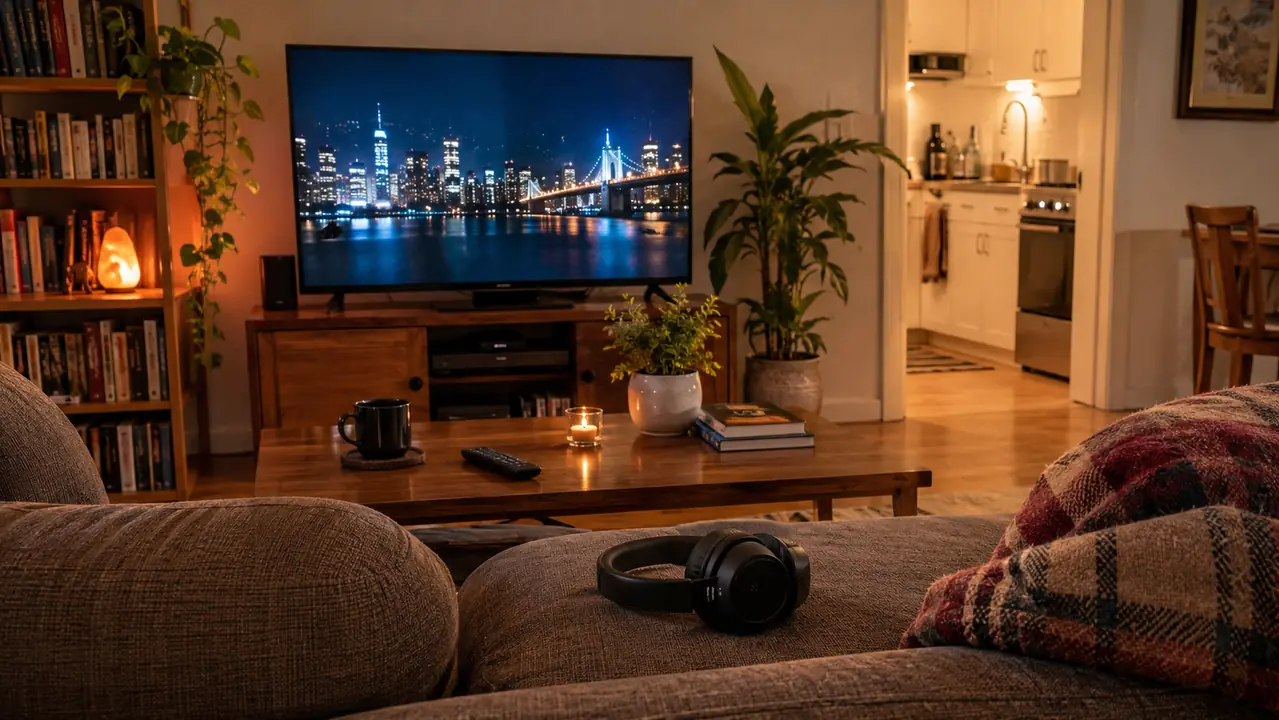
Our family room is not a home theater. There is a 50-inch television on a low cabinet, a sofa about ten feet back, and a small kitchen just off the room where the dishwasher runs through the second half of everything. Ten feet is the number that matters here. At ten feet, with the volume set where Sal finds it comfortable, I was catching about two words in three. The SE5000 closed that gap without moving a stick of furniture. I measured the ten feet with the same tape I use for bookshelves, because I wanted to know whether the distance was my imagination or the actual problem, and it turned out to be the actual problem.
The routine takes about four seconds. I sit down, put on the headphones, turn the wheel until the dialogue sits just above the room, and set the unit on the cushion beside my hip. The wheel has detents, small stops you can feel rather than hear, so two clicks is a real measurement and not a guess. During commercials I turn it down, because advertisers master their sound louder than the shows do and I do not need a car commercial at that level in my ear.
The first week I kept a notepad on the armrest, because that is what I do with anything new. I wrote down the night, the program, and a one-word verdict. Tuesday, mystery, better. Wednesday, cooking show, no real difference. Thursday, football, better for the announcers and worse for the crowd, which is a strange sentence to write and an accurate one. By the second week the notepad had stopped earning its place, because the answer was the same every night and I had other things to do with my evening.
My viewing runs to British mysteries, cooking shows and Bills games, roughly in that order of difficulty. Cooking shows almost never need amplification, because the hosts face the camera and speak in finished sentences. Football needs it for the announcers and not for the crowd. Mysteries need it every single time. If a scene is set in a pub with a music score under the dialogue, ten feet might as well be thirty.
What It Does Well, Night After Night
The thing that surprised me is how much of comprehension is consonants. Vowels carry perfectly well at low volume. What I lose first are the t, the s, the k, the ends of words, which is why a line can arrive sounding like an agreeable mumble and mean the exact opposite. Amplified, those edges come back. I stopped guessing at plot points. That sounds small until you have spent two years guessing.
There was a night in October, a two-part mystery, and a character said a name I had been mishearing for an entire season. I had been carrying the wrong name in my head since September, which meant I had also been carrying the wrong suspect. When the reveal came I was not surprised. I was corrected. That is the distance between amplification and captions, and it is the reason I stopped treating this as a temporary measure while I made up my mind about hearing aids.
The second thing is what it did to Sal. He is 68, retired from the mail, and his hearing is fine. For years he was the one turning the television up and I was the one pretending I could follow. Now the set sits at his level and I do my own adjusting on my own head. Nobody in this house has said what twice in a row since the spring.
And there is no setup. No pairing, no menu, no update, no discovering at nine in the evening that the device and the television have stopped speaking to each other. I turn a wheel. That is the entire interaction, and after months of it I have come to think that is the most underrated thing about the whole category. Anyone who has talked a parent through a wireless pairing over the telephone knows exactly what I mean. There is a reason the SuperEar stays in my routine and the smart speaker in the kitchen does not.
Where It Falls Short
Here is the honest part. Because the SE5000 amplifies the room rather than the broadcast, it amplifies the room. The dishwasher. The furnace kicking on in November. Sal's recliner. A car going past the front window with a bad muffler. All of it arrives at the same gain as the dialogue you were trying to hear, and the dialogue is the thing you cannot rewind.
Rochester gives you a real test of this. The furnace comes on in October and runs until April, and ours sits in the basement directly under the family room. On the first cold night of the year I turned the wheel up twice during a quiet scene, heard the burner instead of the actors, and turned it back down. From November through March I do my listening with half an ear out for the furnace cycle, and I have learned to catch the important exchanges in the gaps between it.
Where I set it down matters more than I expected. On the cushion beside me the sound is clear. Under the blanket I keep over my knees in January it goes dull and far away, because I have effectively put a lid on it. I learned to leave it on the armrest or clipped to me where nothing covers it. It is a two-second habit now, but for the first week I blamed the device for my own blanket.
It also cannot repair a bad mix or a heavy accent. There is one Scottish detective series that defeats me at any volume, and I have made peace with watching that one with subtitles and a cup of tea. If a score is louder than the actors on purpose, no amplifier in the world separates them for you.
And it is not a hearing aid, and it does not pretend to be one. It does not shape sound to my audiogram. It does not sort a single voice out of a crowded restaurant. I still go for my checkups, and if the day comes when my audiologist tells me a fitted device is the right next step, I will listen. A personal amplifier is a tool for one specific job, and this one does that job well.
The Volume Wheel, the Battery and the Belt Clip
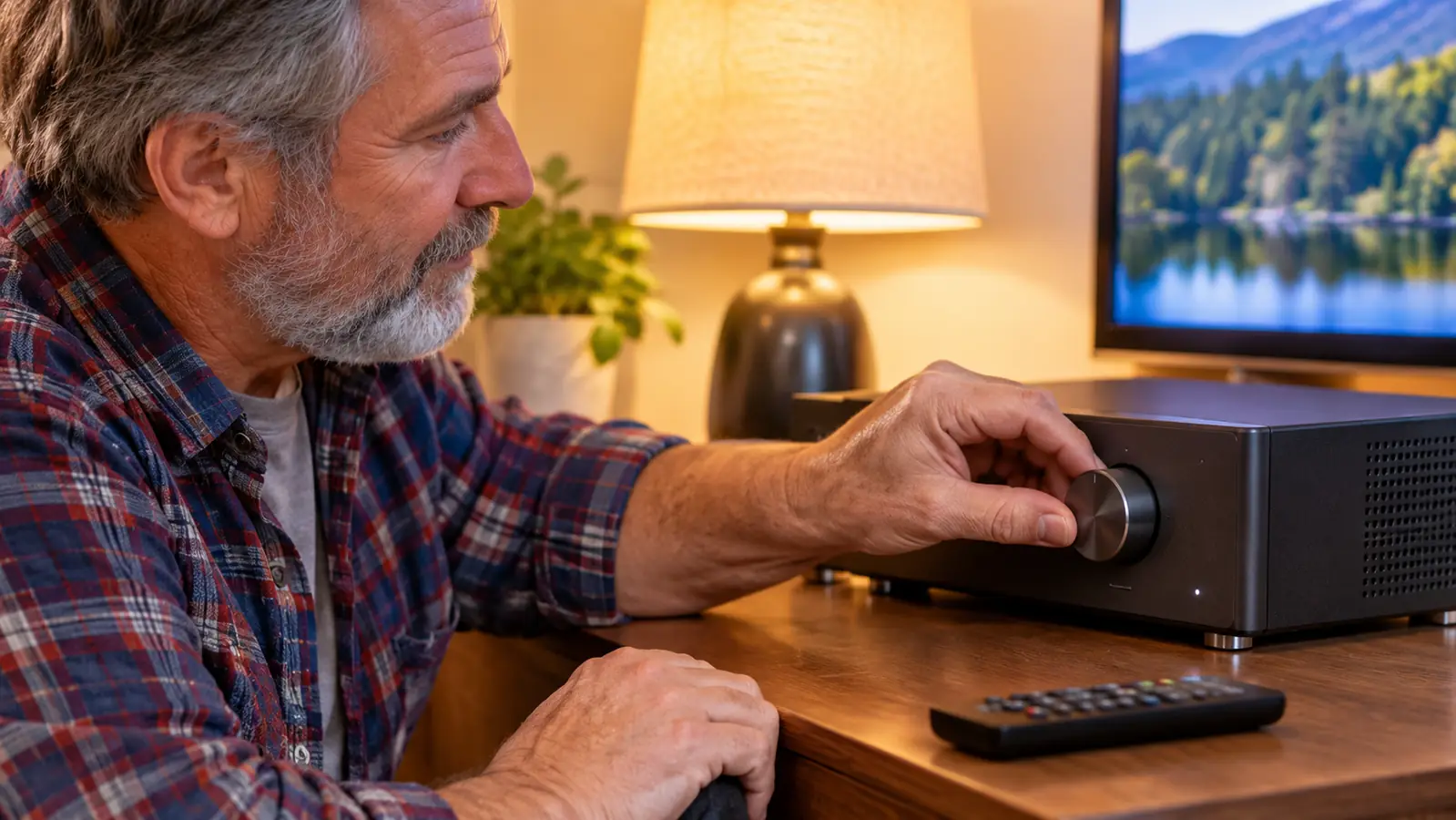
The control is a tactile wheel you turn with a thumb, and it has enough resistance to stay where you put it. There is no display, no app, no menu, no sequence of button presses to memorize. In a dark room I can find the wheel by feel and nudge it two clicks without looking away from the screen. For anyone who has handed a parent a device with six buttons and watched their face fall, this is the whole argument in one sentence.
The unit measures 4 by 0.85 by 3.5 inches and weighs half an ounce, so it lives in the drawer of the end table and travels to the kitchen counter when I am listening to the radio while I chop. That half ounce is also why the belt clip works. Clipped to the neck of a cardigan it stays put and I forget it is there. The first time I did that I walked into the kitchen to check the oven, forgetting entirely, which is exactly the sort of thing the clip is for. The second time I forgot the headphones were still on my head and took the whole assembly with me, which is exactly the sort of thing no clip can prevent.
The SuperEar SE5000 takes one AAA battery, and one is included, which meant I could use it the night it arrived instead of the night after a trip to the store. I keep a card of AAA batteries in the same end-table drawer. I am not going to quote you a number of nights per battery, because it depends how long you leave it running and I have never once remembered to write it down. The sound thins out a little before it goes, and that is my cue.
Headphones, Earbuds and Sunday Afternoons
The box includes two ways to listen: a pair of deluxe stereo headphones and a set of discreet stereo earbuds. I expected to pick one and ignore the other. What actually happened is that they split by situation. The over-ear headphones are what I wear for a mystery on a Tuesday, because they are comfortable for two hours and they shut out the dishwasher on their own.
The earbuds come out on Sundays, when the two grandkids visit and the family room stops being mine. I can keep half an ear on the game and still hear what is happening in the room, which is the correct priority on a Sunday. They are also what I would pack for a trip, since they take up less space than my glasses case.
Sunday afternoons have their own arithmetic. Two grandkids, one game, and a sofa that was never built for four. The earbuds mean I can sit on the floor with a plate on my knee and still hear the commentary. The over-ears mean that when the game is over and the house is quiet again, I can go back to a mystery at full attention. I did not plan on a product that changes jobs with the day of the week. It turned out to be the most useful thing about the box.
Both of them run from the same unit, so there is nothing to charge separately and nothing to lose in a different room. The belt clip is the third piece I did not expect to use and now do, mostly when I am moving between the kitchen and the sofa during a timeout.
What I Liked
- Makes television dialogue intelligible at an ordinary room volume, with no changes to the set
- One tactile wheel and nothing else, so there is no menu or pairing to relearn
- Over-ear headphones and discreet earbuds both included, so it suits two different kinds of evening
- Half an ounce and pocket-sized, so it moves from the family room to the kitchen and back
- No connection to the television means no compatibility question and no cable to run
Where It Falls Short
- It amplifies the room, so the dishwasher, the furnace and passing traffic come up with the dialogue
- Heavy accents and dialogue buried under a music score still resist it
- Needs an uncovered spot to work well, so a blanket or a drawer dulls it
- Runs on a AAA battery you will occasionally forget to replace
- Not a hearing aid, and no substitute for a proper fitting if your loss is more than mild
At ten feet, with the volume set where Sal finds it comfortable, I was catching about two words in three. The SE5000 closed that gap without moving a stick of furniture.
Who This Is For
This is for the person who can follow a cooking show but not a mystery, who has mild to moderate age-related hearing loss and has not yet gone down the hearing aid road, and who is tired of asking a spouse to repeat the plot. It suits a couple with one good set of ears and one tired set, because it lets each of you adjust your own listening without a negotiation every night.
It also suits anyone who wants the television louder in their ear and not in the rest of the house. If someone is asleep upstairs, or if you live in an apartment with a shared wall, that distinction is worth more than any feature list. I would tell a friend in that situation to start here before spending an evening researching wireless transmitters for a television they may not need to touch. And if you want the shorter version of my reasoning, I wrote a separate list of the reasons a personal sound amplifier suits TV nights, which is essentially this article with the anecdotes removed.
Who Should Skip It
Skip it if your hearing loss is beyond mild to moderate, if you need one voice separated from a noisy room, or if a professional has already told you that a fitted device is the right answer. An amplifier turns up everything in front of it. It does not do the sorting work that a properly fitted hearing aid does, and it should not be asked to.
Skip it, too, if what you actually want is the television's own audio delivered straight to your ears with no room in between. That is a different category of product, and I compared this one against a pocket amplifier in a separate piece if you want the closer look. The SuperEar listens to the room. That is its charm and its ceiling, and it is better to know which one you are buying before the box arrives.
If the volume talks in your house sound like the ones in ours did
Same wheel, same headphones, same half ounce in the end-table drawer. Read the listing yourself, then decide whether your family room has ten feet and a dishwasher in it.
Amazon See the SuperEar SE5000 on Amazon →