

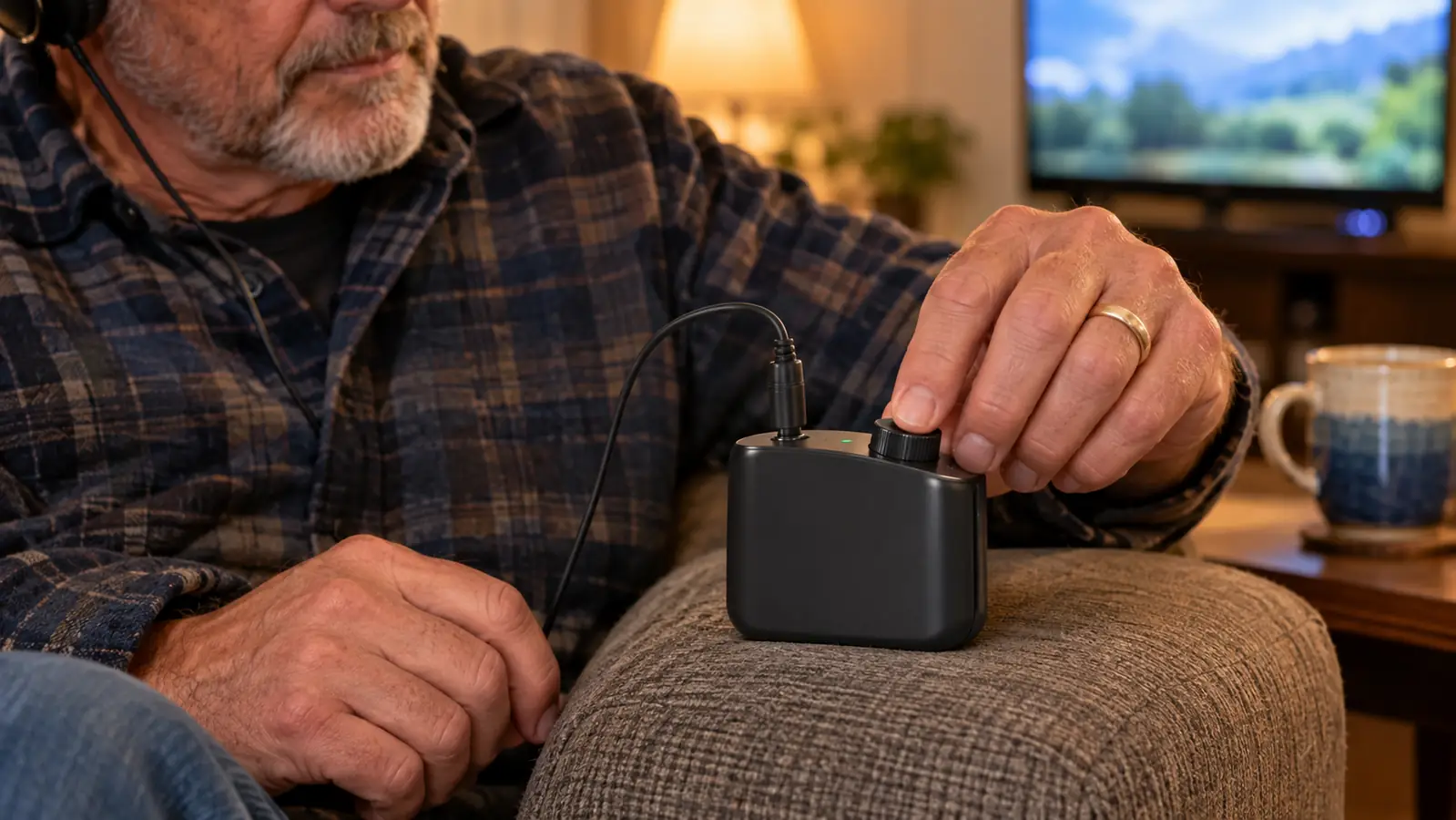
Short answer first, because that is what I wanted when I was the one deciding. If your sofa sits about ten feet from the television and your goal is to follow dialogue without pushing the volume into the thirties, the SuperEar SE5000 is the easier device to live with. It is a small amplifier, four inches by three and a half and half an ounce on the scale, with a belt clip and a textured volume wheel you can find without looking. In the box you get the amplifier, a pair of stereo headphones, a pair of earbuds, and the AAA battery it runs on. I put the battery in, plugged in the headphones, and was watching an episode of Vera within four minutes.
The pocket amplifier is not a worse version of the same tool. It is a different tool that solves an overlapping problem. The one I borrowed for a month is the Pocketalker style: a small unit worn on a cord, with a separate microphone on a cable that you aim at whatever you want to hear. Pointed at a television speaker it does a lovely job. The catch is that the microphone has to sit near the sound, so a cord runs from the front of the room back to your chair. This is a comparison of two devices in one family room, not a verdict on the category. I am a retired school librarian, not an audiologist, so treat it as notes from a user.
The Ten-Foot Sofa Problem, Described Plainly
Our family room is not big. The television is a 50-inch set on a low cabinet, the sofa is roughly ten feet back, and the kitchen is just off it, which matters because Sal makes tea in the middle of the second half. At ten feet and a normal volume, I do not lose the loud parts. I lose the soft consonants. The difference between 'he could' and 'we could' simply disappears, and a British mystery where everyone murmurs under the music is the hardest thing I watch all week.
Sal has normal hearing and used to wince at the volume. So the trouble was never really volume. It was that the two of us needed different amounts of it at the same time, in the same room. Any device that fixes that has to either bring the sound closer to my ears or hand me my own control of it. That is the whole contest. Everything below is a detail of how the two devices do those two jobs.
One note before we go further. Neither device is a hearing aid, and neither one is a substitute for a hearing test. I was diagnosed with mild to moderate age-related hearing loss three years ago and I am not wearing prescription aids yet. If you have not been tested, get tested. These are listening tools for a specific job, and they are good at that job.
How I Compared Them
I used each device for at least a week in the room where I actually watch television, at the same ten-foot distance, on the same three programs: a British mystery, a cooking show, and a football game. I kept a notebook, which is a habit from thirty-one years in a school library and probably the reason this article exists at all. I wrote down what I could follow without asking Sal to repeat himself, because that is the only measure that has ever mattered to me.
I did not test either one with a hearing aid, because I do not wear one. I did not test outdoors. I did not measure decibels, because I do not own the equipment and a number would have made this look more scientific than it is. There is no price column in the table below and no score out of ten. What follows is a report of what I heard, and what annoyed me, over about six weeks in one house in Rochester.
| SuperEar SE5000 | Pocketalker-style pocket amplifier | |
|---|---|---|
| How it picks up sound | Used near the television, it amplifies what comes out of the TV speakers. Nothing to aim. | A separate microphone on a cable that you point at the sound source. |
| Where you wear it | Belt clip, or set it down within reach on the sofa arm. | Worn on a cord around the neck in most versions of this design. |
| Volume control | A tactile wheel with a grip you can find by feel in a dark room. | A wheel on the body, set by touch. |
| Headphones in the box | Deluxe stereo headphones and discreet stereo earbuds, both included. | Often sold as the amplifier alone, so check what the kit includes. |
| Cord across the floor | None. | One, from the television to your chair, unless you sit close. |
| Aiming at one talker | Amplifies the whole room, background included. | The microphone can be held or pointed close to one person. |
| Connects to the TV directly | No. It amplifies the sound in the room and does not connect directly or wirelessly. | No, not on this design either. |
| Setup the first time | Battery in, headphones on, wheel adjusted. Under five minutes. | Battery in, microphone placed and aimed, cable run to the chair, headphones on. |
| Best for | One fixed seat about ten feet from one television. | The kitchen table, the car, a one-on-one conversation. |
I read that table by asking which column describes my Tuesday night. The two rows where the pocket amplifier wins are real wins and I will get to them properly. They are simply not rows that come up while I am watching a detective show from the same cushion I always use.
Where SuperEar Wins
The first advantage is that there is nothing to aim. The SuperEar sits within reach and amplifies what comes out of the television speakers. I do not run a cable anywhere and I do not think about placement. On a ten-foot sofa that is the entire job. I set it on the arm of the sofa, put the headphones on, and the sound is at my ears instead of travelling across the room and losing its edges on the way.
The second is the box. The headphones are included and so are the earbuds, and I have used both. The headphones are what I reach for on a Sunday with the Bills on. The earbuds are what I use when Sal is reading beside me and I do not want to look like an air traffic controller. Having both in the package means I did not have to go buy anything in order to find out whether the idea worked in my own room.
The third is the volume wheel. It is tactile, which is a librarian's word for textured, and it means I can turn the thing down during a commercial break without taking my eyes off the screen. Half an ounce, four inches by three and a half, and it disappears on the belt clip or the sofa arm. The AAA battery is in the box, so the first evening is not spent hunting through a kitchen drawer for one.
And the fourth, which sounds small and is not: the wheel holds where I leave it. In six weeks I have adjusted it between programs and never once during one. A device you have to fiddle with is a device you stop using by the third night. This one I stopped noticing, which is the highest compliment I can pay a piece of household equipment.
Where the Pocketalker-Style Amplifier Wins
A microphone you can aim beats one you cannot. That is the honest core of it. When one of my grandchildren reads to me at the kitchen table, or when Sal is telling a story from the far side of the room, the pocket amplifier lets me put the microphone close to the mouth that matters and leave everything else at its normal level. The SuperEar amplifies what is already in the air, and what is already in the air includes the furnace and the dishwasher.
It is also the better tool for conversation in general. A pocket amplifier is built to be carried, worn on a cord and pointed, and that is worth more at a restaurant table or in a car than anything in the table above. If your week is mostly one-on-one talking and only occasionally television, that difference should decide the purchase. The right tool for the sofa is not automatically the right tool for the rest of your life.
At ten feet and a normal volume, the difference between 'he could' and 'we could' simply disappears.
For one sofa and one television, this is the one I kept
Stereo headphones, earbuds, a belt clip and the AAA battery all come in the box. There is no cable to run from the television and no microphone to aim. It sits on the arm of the sofa and does the job in about four minutes.
Amazon Check Today's Price on Amazon →
What Neither One Does
Neither device connects to the television directly or wirelessly. That surprised me when I read the manual, because I had assumed everything was Bluetooth by now. The SuperEar amplifies the sound already coming out of the TV speakers, which means it works with any television ever made and also means the room is still part of the equation. If someone is running a blender in the kitchen, the amplifier is faithful to that too.
If you want the sound piped straight from the set to your ears with nothing in between, that is a different category of product: a wireless TV listening system with a transmitter on the back of the set. It is a fine thing to buy. It is also more setup, more cables behind the cabinet, and more to go wrong. I mention it because I wish someone had explained the difference to me before I spent a whole evening reading listings in confusion.
Six Weeks of Actual Watching
I have used the SuperEar for six weeks on the cushion nearest the lamp. The pattern is dull and that is the point: battery in, headphones on, wheel adjusted once, and then nothing for two hours. The one change I make is between a cooking show and a mystery, because the cooking show is mixed louder. I have not had to change the battery yet, though I keep a spare AAA in the drawer next to the coasters.
I also tried the pocket amplifier at the sofa for a full week, so this would not be an unfair fight. It worked. The sound was clean and I heard dialogue I had been missing for years. But the microphone sat on the cabinet under the television and the cable ran along the floor to my chair, and Sal crossed it twice on his way to the kitchen. By Thursday I had moved it back to the kitchen table, where it earns its keep.
Who Should Buy Which
Buy the SuperEar SE5000 if the problem is a fixed seat and a television. If you watch from the same cushion every night, if the volume argument has been running for years, and if you want to be listening five minutes after the parcel arrives, this is the simpler answer. It is also the better choice when you are buying for someone who will not tolerate a setup process. Nothing needs aiming, both headsets are in the box, and the wheel is easy to find without looking.
Buy a pocket amplifier instead if your days are mostly conversation. If you are at a table, in a car, at a church supper, or in a waiting room, the microphone on a cable is the more useful design, and the sofa becomes the occasional case rather than the main one. Some households will sensibly own both, and I would not call that extravagant. A device that lives where you need it gets used; a device that lives in a drawer does not.
If you are still deciding, start with the seat you sit in most often. Mine is a sofa ten feet from a 50-inch screen, with a husband who no longer winces and a mystery series I can finally follow without subtitles. That is a narrow problem, and the SuperEar is a narrow tool that fits it. Your sofa may be a kitchen table, and if it is, the other one is waiting for you and it is a good device too.
The amplifier that earned the arm of the sofa
No cable across the rug, no microphone to point, and a volume wheel you can work in the dark. If dialogue is the first thing you lose, this is where I would start.
Amazon Check Today's Price on Amazon →