
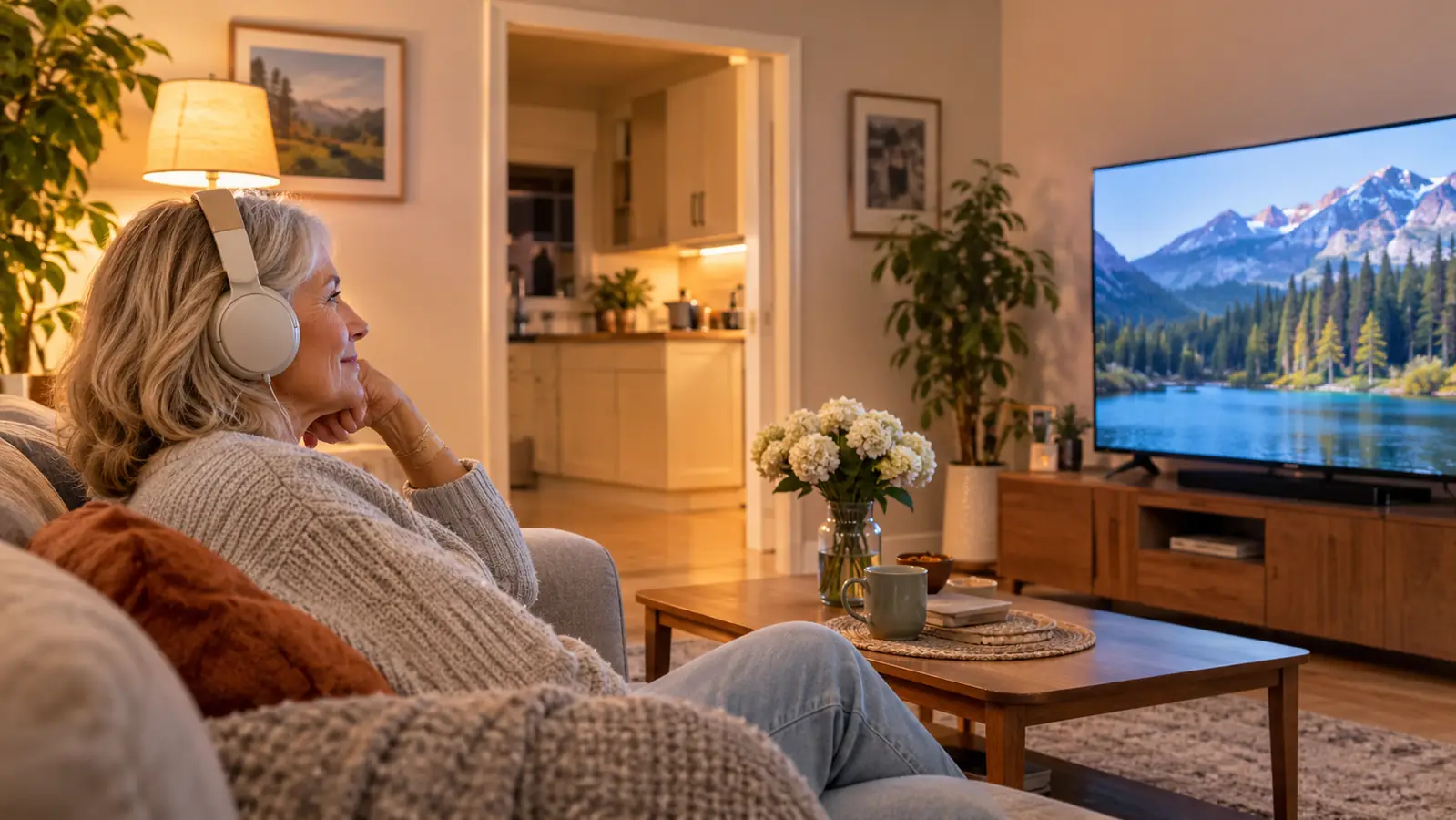
For about four years, the loudest sound in our family room was not the television. It was Sal saying, turn it down a notch. I would turn it down. Then the dialogue in whatever British mystery we were watching would drop to a murmur and I would turn it back up, and around we would go. I have mild to moderate age-related hearing loss in both ears, diagnosed three years ago, and it shows up first in exactly that spot: soft voices, fast dialogue, and anyone speaking over background music. I am not an audiologist. I am a retired middle-school librarian who reads the manual cover to cover and keeps notes. These are the notes.
The headphones that ended up living with us are the Avantree HT5009. They arrived as a test and stayed, which is the only kind of review I know how to write. Sal is 68 and hears normally; I am 66 and do not. The trick was finding something that helped me without turning our family room into a private screening. Ten reasons later, that is what the Avantree set does. There is a longer version of these notes somewhere else, but here is the list I would actually hand to a friend at church.
Four years of up and down, ended by one small box
The Avantree HT5009 plugs into the back of the television and the volume argument stops. Clear Dialogue Mode, pass-through so the room still hears it, and no pairing ceremony.
Amazon Check Today's Price on Amazon →The dialogue sits in front of the music instead of under it
British mysteries are the hardest test I know. Someone murmurs in a drawing room while a cello plays underneath, and the cello always wins. Clear Dialogue Mode is the setting that pushes the speaking range forward, and I leave it on permanently. The first evening I used it, we watched an episode of a detective series we had already given up on, and I followed the whole thing without once asking Sal what was said. He noticed before I did. That is the whole reason this set stayed in the house.
I can raise the speech without raising the whole room
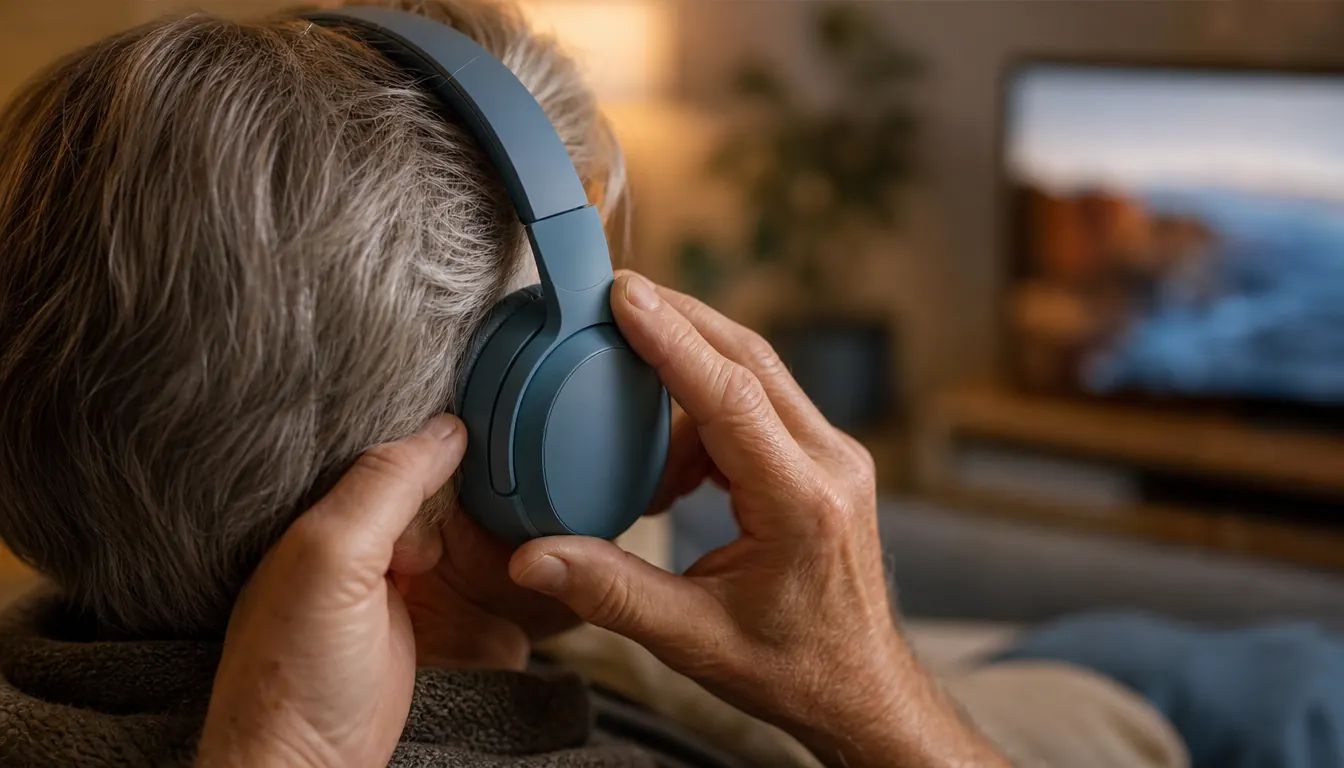
Sal likes the television at a level that does not bother him. I used to like it at a level that bothered him considerably. With the headphones on, I set the TV where he wants it and adjust the sound on my own earcup with the buttons there. Enhanced Volume gives me more room at the top than the television speakers ever did, which matters on a cooking show when someone is talking into a pan. Nobody in the room compromises. That ended a four-year negotiation in about a week.
Setup was one cable, not a pairing ceremony
Bluetooth pairing is the part of modern life I resent most. This set avoids it. The transmitter plugs into the back of the television and the headphones find it. I did the whole thing on a Tuesday afternoon with the manual open on my knee, and the manual was almost unnecessary. If your television has an optical, AUX or RCA output, that is the connection you use. If it has Bluetooth built in, the headphones can pair with it directly. Either way: no passcode, no holding two buttons for ten seconds and hoping.
Pass-through means Sal still hears the television
Pass-through support is the feature I did not know I wanted. It means the television keeps sending sound to its own speakers while the headphones are running, so Sal hears the game at his volume and I hear it at mine, at the same time, from the same screen. I had assumed headphones meant one person watching and one person waiting. They do not. He can be in the kitchen and still hear the play-by-play, and I can be on the sofa with the crowd noise turned down to something my ears can live with.
The words match the mouths, every time
Audio delay is what makes people give up on television headphones. If the sound lags the picture by even a fraction, you get a puppet show, and once you notice it you cannot unnotice it. The Avantree set does not do that. Mouths move and words arrive together. I tested it the suspicious way, watching a news anchor and then a football referee, because those are the two places a mismatch shows up immediately. Nothing. I stopped checking after a week, which is the highest compliment I give to a piece of technology.

Forty hours between charges, so I stopped thinking about it
Forty hours of listening on a charge. I watch two or three hours in the evening, so that is roughly two weeks of use before I plug anything in. I do not think about the battery at all, which is the point. My old routine was a pair of earbuds that died in the middle of the second act and a hunt for a charging cable in the dark. Now the headphones live on the arm of the sofa and get charged on a Sunday afternoon while the grandkids are here, whether they need it or not.
One hundred sixty-four feet of rope, and I have used most of it
Our kitchen sits just off the family room, and I can start dinner, keep listening to the second half, and still hear Sal ask whether I am coming back. The signal holds through the wall. I would not claim it works from the far end of a garden, because I have not tried, but from the stove to the sofa is not a test at all. For anyone who cooks during a game or folds laundry during a mystery, this is the detail that quietly matters more than the sound quality.
They sit around my ears, not on my glasses
Over-ear matters when you have worn glasses since you were nine. The earcups sit around my ears instead of pressing on the arms of my frames, and the whole set weighs about 196 grams, which is lighter than the hardback I was reading last week. I have worn them through a full three-hour evening and forgotten they were on, and that is the only comfort test that counts. A set you take off after twenty minutes is a set that stays in a drawer no matter how good it sounds.
It works with the television I already own
I did not want to buy a new television in order to hear the one I have. The HT5009 works with the set already in the family room through its optical connection, and it would work just as well through AUX or RCA. A friend of ours has a newer set with Bluetooth built in and pairs the headphones straight to it, no transmitter in the back. If you are wondering whether your television will cooperate, the answer is almost always yes, and the answer is printed on the connection panel behind it.
Two years of cover, and a manual I could actually read
The warranty runs twenty-four months, which is two years of not worrying about a thing that sits on a sofa arm and occasionally gets sat on. I registered it the week it arrived, because I have learned that lesson the hard way with a coffee maker. The documentation is written in plain language and covers the transmitter, the connections and the headphones together. For a household item used every single evening, that is not a marketing line. It is the difference between a purchase and a decision I stop revisiting.
What I'd Skip
What I would skip is the assumption that this is a hearing aid. It is not, and I say that as someone who does not wear hearing aids yet. If you are turning the television up and the conversation down, book the hearing test first, because headphones make a wonderful bridge and a poor substitute. I would also skip the soundbar upgrade, which cost a friend of mine a great deal and solved nothing at all about dialogue. And if only one person in your house struggles, skip buying two pairs. One set, one transmitter, and pass-through keeps the other person in the room.
I have not asked Sal to repeat a line of dialogue since the set arrived, and he has not asked me to turn it down. Four years of that, gone.
Start with the hearing test. Then put one cable in the back of the TV.
The Avantree HT5009 is the bridge, not the cure. Clear Dialogue Mode, pass-through for the room, 40 hours a charge, and a manual you can read in one sitting.
Amazon Check Today's Price on Amazon →