
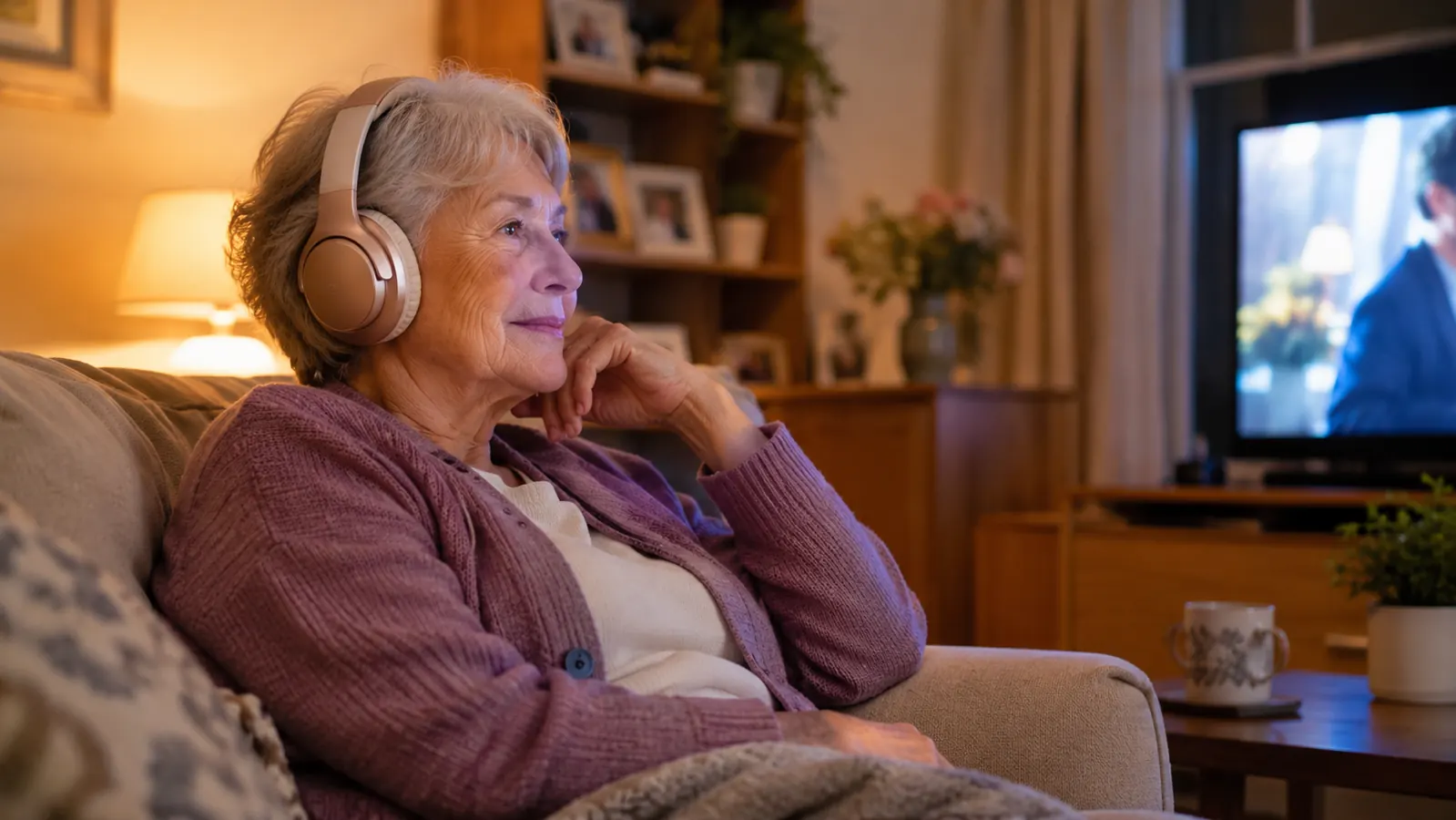
Sal and I have been negotiating over the television volume for eleven years. Our sofa sits about ten feet from the screen, which turns out to be exactly the distance where a modern flat panel stops being helpful. Close enough that you can hear music playing. Too far to catch what the detective actually said. For a long time I blamed the sound mix on the British mysteries we watch. Then I had my hearing tested three years ago, mild to moderate loss in both ears, and I stopped blaming the BBC. So I did what a retired librarian does with a problem. I read the manuals. Two of them, side by side: the Avantree HT5009 and the Sennheiser RS 120, both sold as wireless headphones for TV watching, both aimed at roughly the same shopper.
The short answer, after eight weeks of switching between them on the same sofa: the Avantree HT5009 is the better fit for a ten-foot room where one person needs the dialogue lifted. The Sennheiser RS 120 is the better fit for the person who wants to set a headset on a base and never think about it again. That is the comparison in two sentences. The rest of this is why I landed there, written down the way I used to write reading notes. I am not an audiologist. I am a sixty-six-year-old woman with a family room, a husband with normal hearing, and a notebook.
| Avantree HT5009 | Sennheiser RS 120 | |
|---|---|---|
| How it connects | Optical, AUX, or RCA cable from the TV, or straight Bluetooth pairing to a smart TV with Bluetooth audio | Analog radio signal from its own base station, which plugs into the TV's audio output |
| First night | Plug in the transmitter, choose the right input, pair once | Set the headset on the base, turn it on, done. Nothing to pair |
| Speech clarity | Clear Dialogue Mode plus an extra volume boost built for speech | Straight analog sound with no speech processing |
| Fit over a long session | Over-ear pads that sit around the ear, 196 g on the head | On-ear pads that press against the ear |
| Range | 164 ft claimed, enough to walk out to the kitchen | Rated in open air, and the radio signal goes through walls too |
| Battery routine | 40 hours per charge, then you recharge it | Runs on standard AAA batteries and charges on its base |
| Volume within reach | Touch and button controls on the headset itself | A volume dial on the right ear cup that a thumb finds in the dark |
| Away from the TV | Works as an ordinary Bluetooth headset with a phone or tablet | A television accessory, and nothing else |
| Best for | One TV, mixed sources, and speech you need lifted | One TV, one viewer, and the simplest possible routine |
How I Tested Both, and What I Was Listening For
I ran each set for a month on the same fifty-inch television, from the same cushion, with the same three programs. A British mystery with heavy regional accents, because that is the hardest listening in our house. A cooking show where the host murmurs under sizzling pans. And Buffalo Bills games, which beat both of the others for difficulty, since the crowd noise sits directly on top of the commentary. I kept notes on three things: how many lines of dialogue I missed, how the pads felt after two hours, and how many times I had to get up to adjust something. I also timed the human startup. Not the technical one. How long from deciding to watch something to having sound in my ears, on a Tuesday night, with forty-five minutes before bed. The first evening I kept a stopwatch on the kitchen counter, and the Avantree took two minutes and forty seconds from plugging in the transmitter to hearing the television. The Sennheiser took about fifteen seconds. I wrote both numbers down and then stopped timing, because after the first night a routine stops being a task and becomes a habit.
One note on method. I did not use a sound meter or any measuring equipment, because I do not own any and would not know how to interpret it. What I have is a pair of ears with a known problem, a husband who will tell me honestly whether the volume in the room is bothering him, and thirty-one years of grading papers, which made me fussy about detail. Treat this as one careful reader's report, not a lab test. And if your hearing has changed recently, get the test before you get the headphones, because no headset on this page fixes a problem that a properly fitted aid would address better.
Why Ten Feet Is the Hard Distance
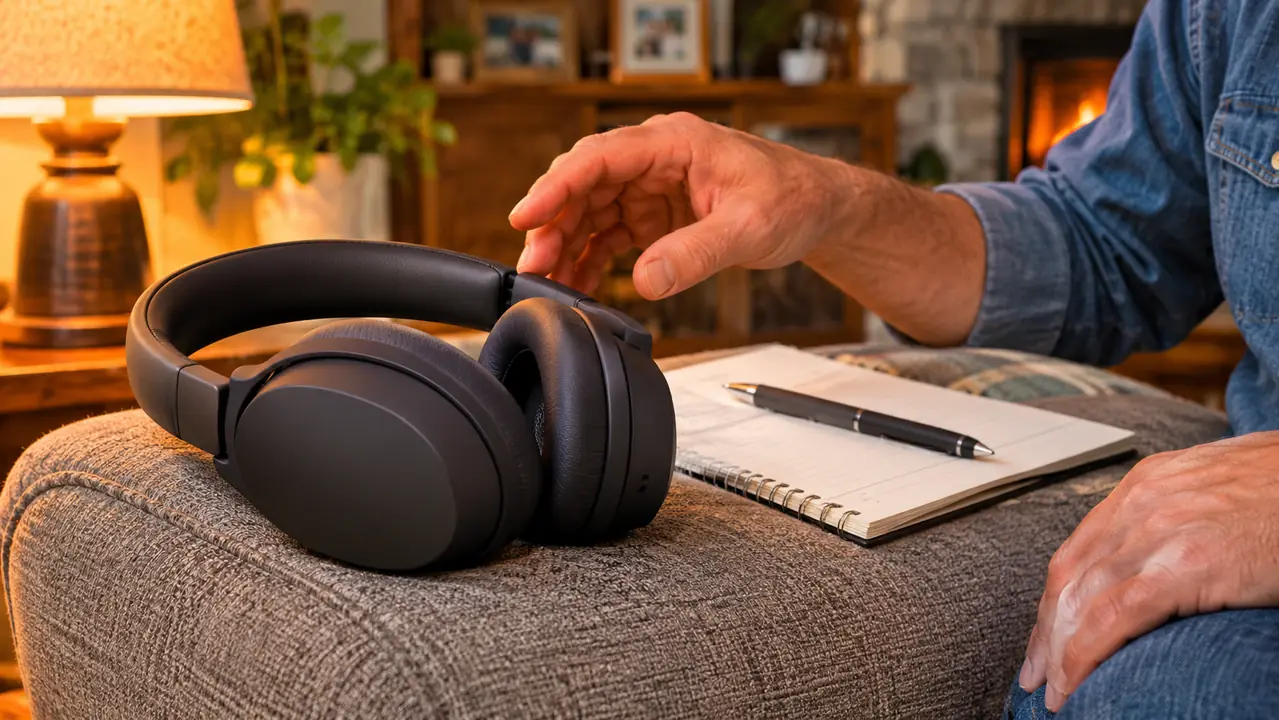
Ten feet is an awkward number. At four feet you hear a television fine. At twenty feet you have given up and looked at soundbars. At ten feet you are close enough to know that dialogue is happening and far enough that the consonants fall apart. The sounds that carry meaning in speech, the t and k and s sounds, the difference between fifty and fifteen, are the first things distance takes away. They are also the first things I lose anyway. So in our family room I am not really fighting the television. I am fighting two things at once: distance, and a sound mix that puts music and effects louder than any human voice.
That is why turning it up never works. At ten feet, more volume lifts the explosions and the score right along with the dialogue, and that is the point where Sal starts wincing and I start feeling guilty. Before either headset arrived I tried the free fixes first, in order. I slid the sofa forward until the front legs were four inches off the rug line, which changed the sound by roughly nothing and made the room feel cramped. I switched on the television's own dialogue enhancer, which made everything sound like it was coming through a cardboard tube. I measured the low cabinet for a soundbar, then read enough to understand that a soundbar makes the room louder without sorting the words out for me specifically. Each of those cost me an evening. What actually helps is a headset that does two separate jobs. It puts the sound an inch from your ear, so distance stops mattering. And it lets you push speech above everything else in the mix. Any wireless TV headset can do the first job. The second job is where these two products go their separate ways.
The Setup Detail That Decides More Than It Should
Before the comparison proper, one practical point, because it decided more for us than any specification on either box. What matters is how your television gets sound out to a headset. The Avantree HT5009's transmitter accepts optical, AUX, or RCA cables, and it can also pair over Bluetooth to a smart television that has Bluetooth audio built in. I tried the RCA cables first, because I had a pair in the drawer from a DVD player we no longer own, and they worked fine. The optical cable gave a cleaner result and left fewer wires behind the cabinet, so that is what stayed. The whole swap took one evening, one flashlight, and one session of lying on the floor. The transmitter also passes the sound through to the television's own speakers, which means Sal can listen at his volume while I listen at mine. That pass-through is the one feature I would not give up, and it is the reason the negotiating stopped.
The Sennheiser RS 120 takes a different route. Its base station connects to the television's audio output and sends an analog radio signal to the headset, the same basic idea as a cordless phone. There is no pairing step and nothing to configure. That is genuinely simpler, and I will say so again below, because it wins that point outright. But it also makes the headset a television accessory and nothing else. It does not become a pair of Bluetooth headphones for your phone, and it has no dialogue setting, because it has no settings beyond volume. Whether that reads as a limitation or a relief depends entirely on who is holding it.
Where the Avantree HT5009 Wins
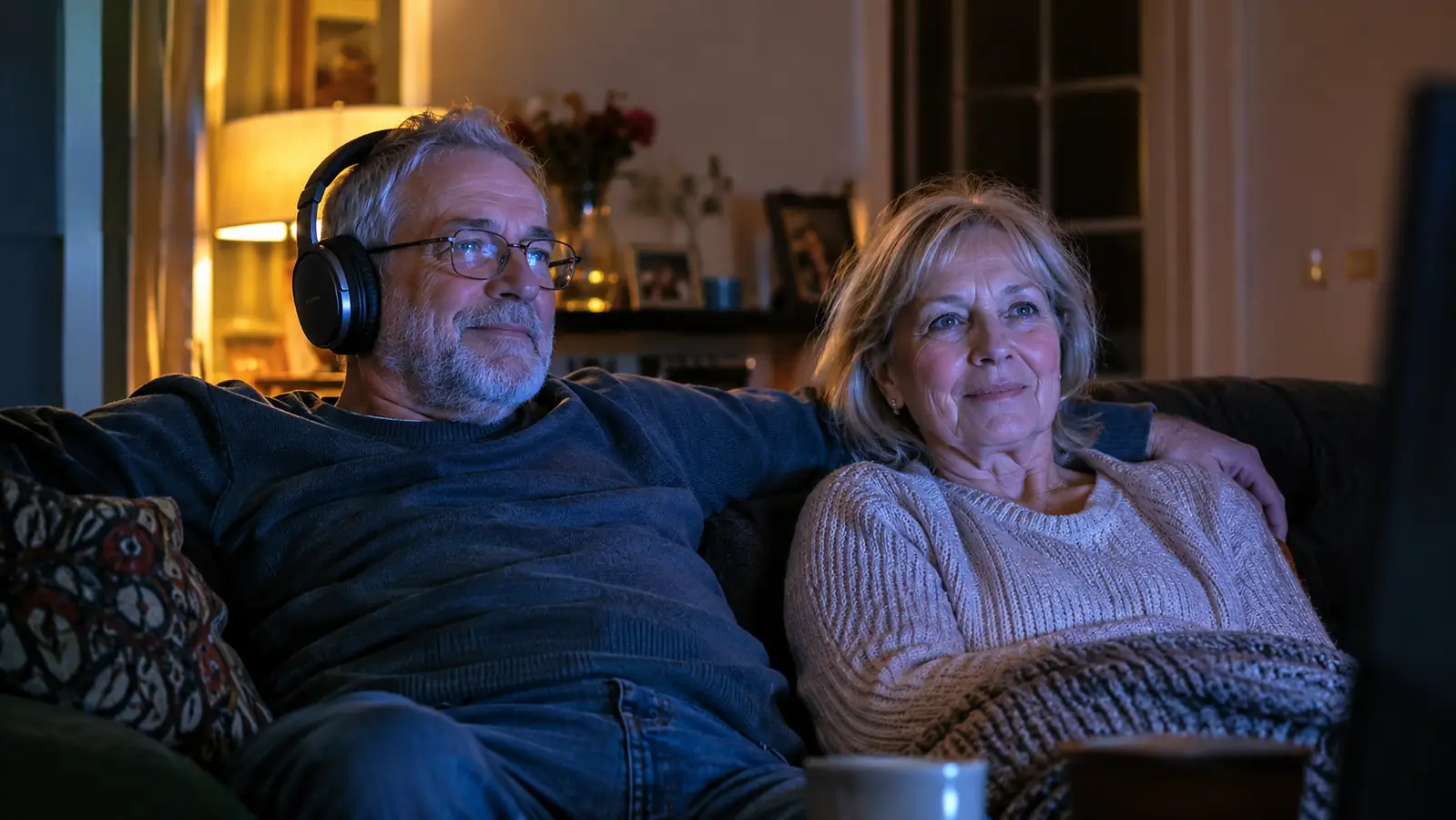
The Avantree has a feature called Clear Dialogue Mode, and it does the specific thing I wanted rather than the general thing. It lifts the part of the sound where speech lives without lifting the explosions sitting underneath it. There is also an extra volume boost beyond what you would get from the television's own output, which matters more than it sounds, because a headset that can only go as loud as the source is no help at all. On the Bills broadcast I could hear the play-by-play over the crowd. On the mystery I caught a name I would otherwise have rewound for. Eight weeks in, my rewind count is way down, and that is the only metric I actually care about. One Thursday in February I paused a mystery four times in the first twenty minutes, every time for the same character mumbling into his coat collar, and then noticed I had watched the previous half hour with the Avantree on and had simply stopped thinking about it.
The second thing it wins on is fit. The HT5009 is an over-ear headset, so the pads sit around the ear instead of pressing on it, and the listing puts the weight at 196 grams. I wore it through a full three-hour game and forgot it was there. The Sennheiser, which sits on the ear rather than around it, was asking to come off after about ninety minutes. And because the HT5009 is a Bluetooth headset underneath the television duties, it also pairs with my phone and my tablet. I listen to audiobooks while I fold laundry. That is not why I chose it, but it is why it lives on the end table instead of in a drawer.
Eight weeks in, my rewind count is way down. That is the only metric I actually care about.
Where the Sennheiser RS 120 Wins
The RS 120 wins the first night. Its base station plugs into the television's audio output and does nothing else. You set the headset on the base, you turn it on, you hear the television. There is no input to choose, no pairing to complete, no question about which cable went where. If your television is older, or if the person who will use it does not want to learn a new device, that is not a small advantage. It is the whole thing. I have handed enough gadgets to enough people over the years to know that the one requiring no explanation gets used, and the clever one gets returned.
The RS 120 also puts the volume dial on the right ear cup, where a thumb finds it in the dark without looking. That sounds trivial until you are forty minutes into a program where the whispers and the gunshots are absurdly far apart and you are adjusting every few minutes. Reaching for a dial you can feel beats hunting for a button you cannot see. There is also a real constituency for what this headset is: an analog device with no digital handshake, nothing to drop, and a charging base that doubles as its home. If you want less capability and fewer decisions, it is the calmer object of the two.
If the dialogue is what you keep missing, this is the set
The Avantree HT5009 is the one I kept on the sofa arm after the eight weeks were up. Clear Dialogue Mode, pass-through support so Sal can listen at his own volume, 40 hours per charge, and an over-ear fit that survives a three-hour game.
Amazon Check Today's Price on Amazon →Who Should Buy Which
Choose the Avantree HT5009 if you are in my situation: mild to moderate hearing loss, a sofa roughly ten feet from the screen, and the specific thing you lose is dialogue. Soft voices, fast exchanges, anyone talking under music. Choose it too if you want one headset that also works with a phone or a tablet, or if two people in this house will use it with different sources, since the transmitter handles optical, AUX, RCA, and Bluetooth. The 24-month warranty on the listing did not hurt either, though I have not had to test it.
Choose the Sennheiser RS 120 if you want the simplest possible routine, if the set will be used by someone who will not tolerate a learning curve, or if you have one television, one viewer, and no interest in Bluetooth anything. It is also the friendlier pick if you have never liked the sealed-in feeling of pads around your ears. And if you are choosing on behalf of a parent or a neighbor, ask them which they would rather have: more control, or less to think about. The answer is usually the second one, and it is usually right.
Neither of these is a hearing aid, and neither replaces the appointment. If you are turning the television up past the point where the person beside you complains, make the appointment first. Then come back and pick a headset with a clear conscience.
The set that stayed on the sofa arm
40 hours per charge, 164 ft of range, pass-through so the room can listen at its own volume, and a Clear Dialogue Mode that earns the name. Sal has stopped wincing.
Amazon See the Avantree HT5009 on Amazon →