
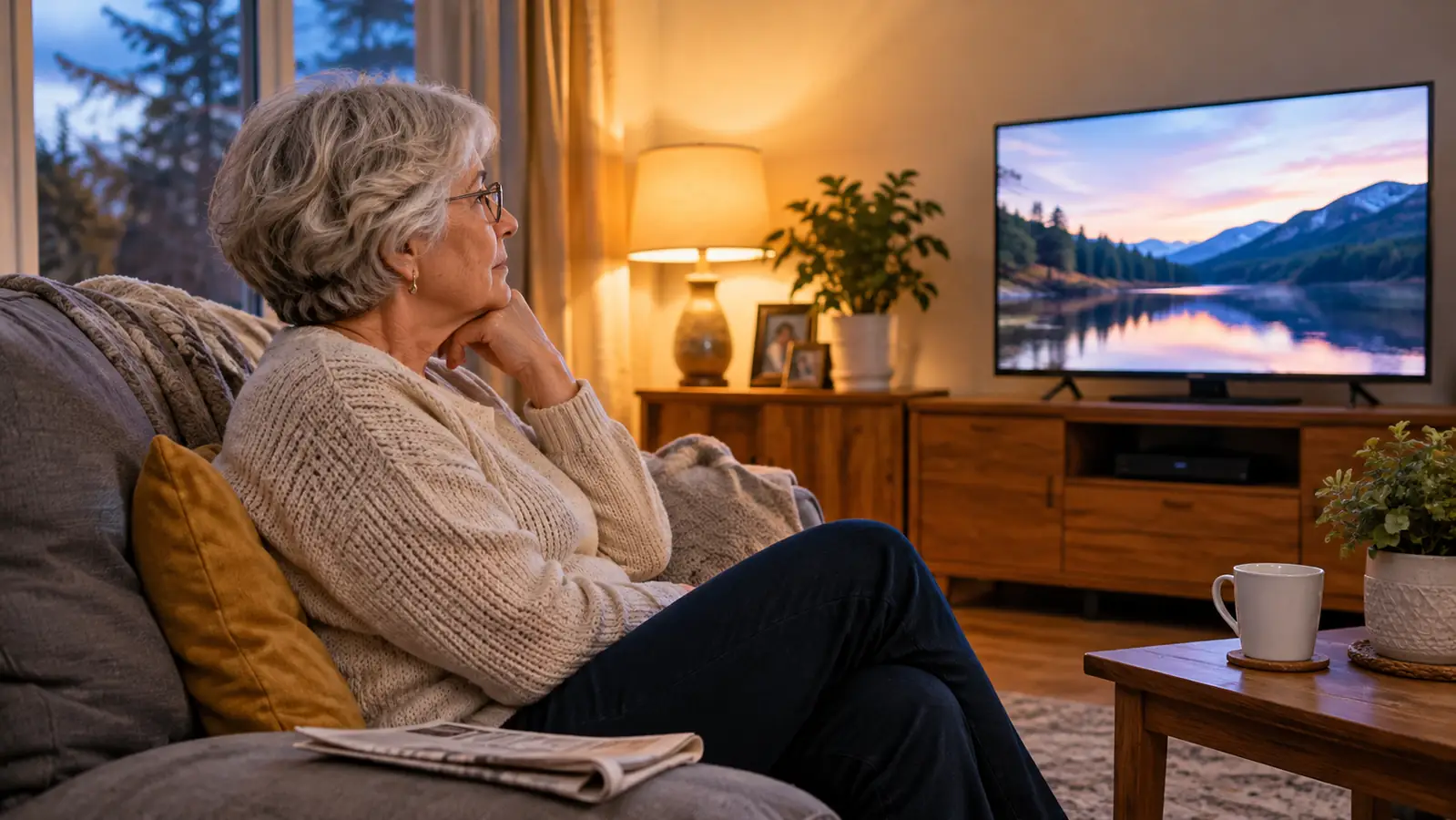
The volume on our television had three settings: too quiet for me, too loud for Sal, and off. Sal is sixty-eight and has the hearing of a man who spent thirty years walking a mail route in every kind of weather. I am sixty-six, a retired middle-school librarian, and three years ago an audiologist confirmed what my family had been repeating to me for a decade: mild to moderate age-related hearing loss in both ears. Soft voices go first. Fast dialogue goes next. Anything with music underneath it is a coin toss.
For a while I did what everyone does. I turned the set up and asked Sal to live with it. Then I tried subtitles on everything, which works, but it takes your eyes off people's faces. What actually helped was not a soundbar and not a hearing aid. It was the SuperEar SE5000, a personal sound amplifier that sits on the sofa arm beside me or clips to my waistband and makes the room louder. I have used it almost nightly since, and these are my setup notes, in the order I really do them.
The Setup That Ended the Volume Argument in Our House
The SuperEar SE5000 arrives with headphones, earbuds, a belt clip and the AAA battery, so there is nothing else to buy before your first episode.
Amazon Check Today's Price on Amazon →Five Steps, in the Order I Do Them
The sequence matters more than any individual setting. If you do the first step last, you will spend a week fighting your own furniture and blaming the device.
Step 1: Set the television to Sal's volume, not yours
The mistake I made for the first month was setting the television to the volume I wanted, then putting the amplifier on top of that. The result was a room that sounded like a stadium and a device working far harder than it needed to.
Now I set the television to the level Sal would choose if he were alone in the house, roughly half of what I used to crank it to, and let the amplifier close the gap. There is a practical reason for this. The small speakers in a flat panel get harsh when you push them. Dialogue does not get clearer above a certain point, it just gets louder and mushier, and the device faithfully amplifies the mush.
A cleaner signal going into the room gives the SuperEar less work to do, and it means Sal can keep watching if I take my headphones off to start the kettle. Nobody has to find the remote and reset everything when I come back.
Step 2: Choose your headphones or the earbuds
The SE5000 package includes two ways to listen: deluxe stereo headphones and a pair of discreet stereo earbuds. I use the headphones in the evening and the earbuds on Sunday afternoons when the grandkids are over, because I still want one ear on the room.
Try both before you decide. The headphones are the ones I reach for, because they cover my ears and push down the furnace and the neighbor's leaf blower as well as lifting the dialogue. The earbuds are smaller and less of an event to put on, which matters when you are only half watching.
Leave whichever you choose on for a full scene before you judge it. Ears take a minute to settle, and the first thirty seconds of any new sound is always strange. One small note I wish someone had given me: headphones worn over reading glasses will drive you mad. Take the glasses off, or rest the arms outside the ear cups.
Step 3: Load the battery and clip it on
The unit runs on a single AAA battery, and one is included in the box, so it works on the first night without a trip to the store. That sounds like a small thing. It is not. Nothing kills a new habit faster than a device that needs an errand before it will turn on. I keep a spare AAA in the drawer beside the sofa, because I know myself.
There is a belt clip in the package. I clip the unit to the waistband of my trousers, or to the arm of the sofa when I am wearing something without a waistband. It weighs half an ounce and measures about four inches by three and a half, so it disappears once it is on.
Where you put it matters. Not under a blanket, not tucked beneath a cushion, and not behind your back. The unit has to pick up the sound in the room, and a lap blanket will muffle it the same way it muffles a conversation.
Step 4: Start the volume wheel low and go up slowly
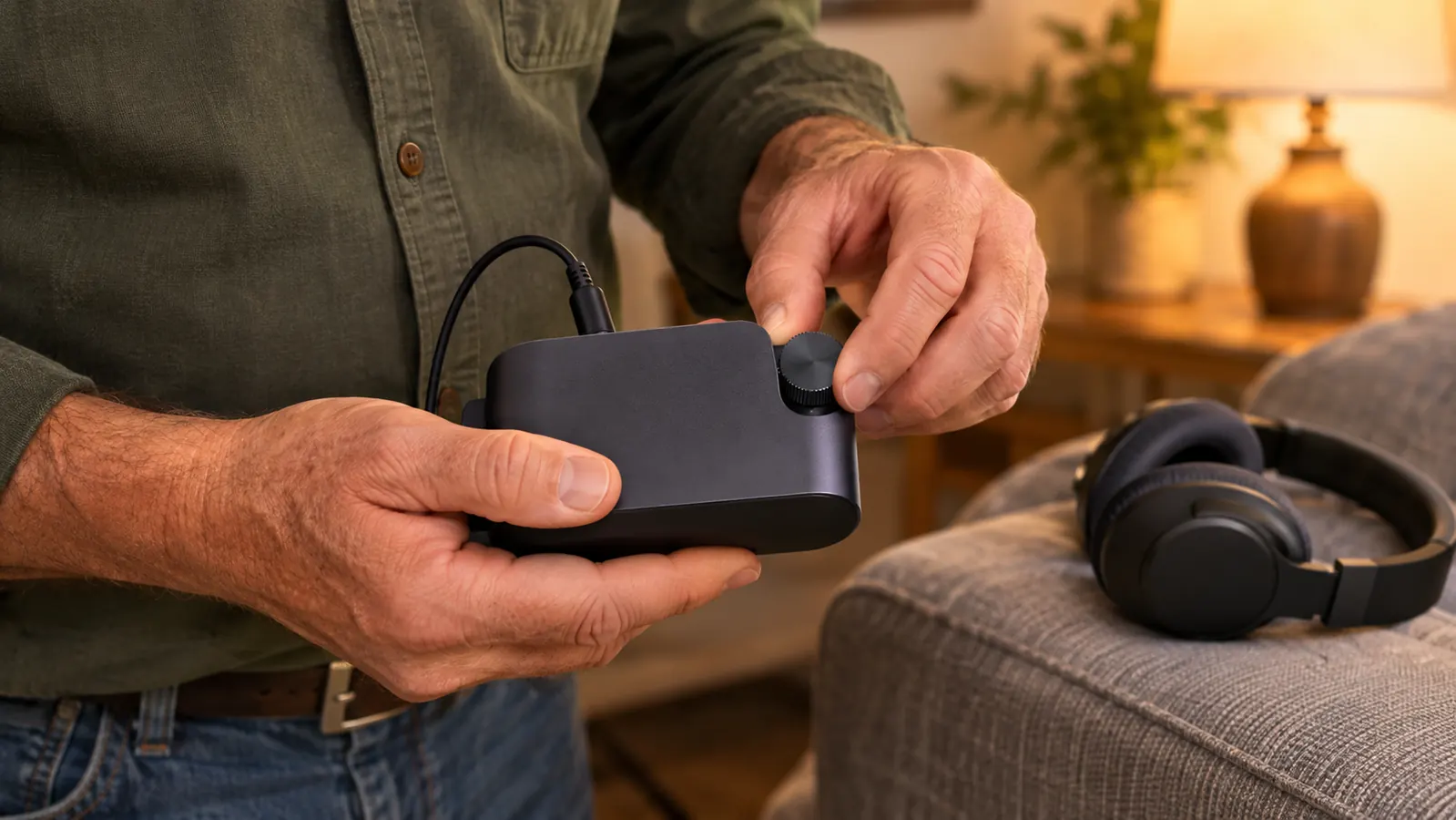
The SuperEar SE5000 has a tactile volume control wheel, which means you turn a ridged wheel and feel each click under your thumb instead of stabbing at a touchscreen in the dark. Start at the bottom. I began where I thought I wanted it and got a burst of theme music that made me yelp and startled Sal out of his crossword.
Turn it up one click at a time, during ordinary dialogue rather than a musical intro. Television is not recorded at a consistent level. The mysteries we watch have quiet conversation and a theme that could wake the street, so I set the wheel for speech and turn it down two clicks when the orchestra arrives. Within a week it becomes automatic, like adjusting the car radio without looking.
I cannot tell you where to set yours. Mine sits roughly a third of the way up for ordinary dialogue, and that number will mean nothing on your television in your room with your ears. Treat it as a starting mark. If everything sounds sharp and hissy, you are too high. If you are still leaning forward, you are too low.
Step 5: Sit where the sound is, and keep the unit clear
We sit about ten feet from a 50-inch set on a low cabinet, which is an ordinary distance and works well. What matters is that the sound has a path. If I set the unit on the cushion beside me and then lean on it, dialogue turns to mush. On the arm of the sofa, or clipped at my waist, it is clear.
Look at where your television speakers actually point. Ours face straight out at the sofa, which is ideal. If yours sit inside a cabinet, or fire back against a wall, you are fighting the furniture and no amplifier wins that fight. Pull the set forward an inch or two if you can, and take it out of the cabinet if there is any way to.
Expect the room to change things. Our kitchen is just off the family room, and when the dishwasher is running I go up two clicks. That is not a fault in the device. It is the same adjustment your ears would make on their own if they still could.
The First Week: What to Expect
The first night is not the test. The first night is exciting, and you will overcorrect, and everything will sound too loud and too bright. The test is the fourth or fifth evening, when you sit down, clip the unit on, turn the wheel to where it was last time, and forget it is there.
Around day three I noticed I had stopped leaning forward. That was the whole point, and I had not realized I was doing it. Around day five Sal mentioned that he had not touched the volume in a while, which he said in the tone of a man who had been waiting two years to say it.
One thing to watch for: if you wear the headphones for four hours straight, your ears will feel tired and a little tender, the way your eyes do after too long at a screen. I take mine off at every commercial break and at the end of each episode. It costs nothing and the next night sounds better.
What Else Helps
The amplifier is the largest single improvement in this house, but it is not the only lever. Subtitles genuinely help with shows that carry heavy accents, and I use them for one British series where every character murmurs into a cup. A rug in front of the television takes some of the bounce out of a hard floor. And Sal has learned to put a hand on my arm before he starts talking, which is worth more than any gadget in the room.
The thing I would urge most: get your hearing tested. I put it off for two years out of vanity. The audiologist was kind, the appointment took about twenty minutes, and I left knowing exactly what I was working with instead of guessing at it. I am not ready for hearing aids, and that is a decision for a professional, not for me and not for a product page.
I would also say this: give it two weeks before you form an opinion. A new listening habit is like a new pair of shoes. The first evening is awkward, the third is tolerable, and somewhere in the second week you stop noticing it at all, which is precisely the goal.
I set the wheel for dialogue, then turn it down two clicks when the orchestra arrives. Within a week it was as automatic as adjusting the car radio.

What It Will Not Do
It will not connect to your television. This is the part people get wrong, so I will be plain about it. The SuperEar SE5000 does not plug into the set and does not pair with it wirelessly. It sits near you and amplifies the sound already in the room, which is why every step above is about seating and TV volume rather than cables and menus. If what you want is a device that streams the television's audio straight to your ears, that is a different product, and worth looking for deliberately.
It also will not replace a hearing aid, and it is not sold as one. It is a listening tool for one specific job, the way a reading light is not a pair of glasses. I say that with affection. It does the job I bought it for exceedingly well, and it does not pretend to do any other.
Who This Suits, and Who Should Start Somewhere Else
It suits someone like me. Mild to moderate loss, one television, a spouse with normal hearing, and no wish to rewire the living room. It also travels well, so it earns a place in a lecture hall or a hotel room where the set is bolted to the wall and the volume is somebody else's decision.
Start somewhere else if your hearing is significantly worse in one ear, if your main frustration is conversation in a noisy restaurant rather than television, or if you have already been told that you need hearing aids. Ask the audiologist first. That is not a disclaimer I tacked on at the end. It is what I did, and I am glad of it.
If you are somewhere in the middle, the ordinary case, then the five steps above are the whole method. Set the television to a polite volume. Choose the headphones or the earbuds. Load the battery. Turn the wheel up slowly while people are talking. Sit where the sound can reach you. That is it. There is no menu to learn and nothing to pair.
If Your Living Room Has a Volume Argument, Start Here
One AAA battery, a set of headphones, a set of earbuds and a belt clip, all in the box. Set the television to a normal level, sit down, and turn the wheel up slowly.
Amazon Check Today's Price on Amazon →