

Three years ago a hearing test came back with the phrase mild to moderate age-related hearing loss, which is a clinical way of saying that soft voices and fast dialogue had begun to slip away from me. The first place I noticed it was not a conversation. It was our television. British mysteries are the worst offenders, all murmured asides and music swelling up over the top of the one line that matters, and I was watching from the sofa with subtitles on while my husband Sal winced at the volume. Sal is sixty-eight and hears perfectly well. That was the whole problem. The volume that worked for me was ruining his evening, and the volume that worked for him left me guessing at the plot.
A neckband listener solved it. Ours is the Avantree HT4186, and I want to lay the setup out plainly, because when I started I could not find it laid out plainly anywhere. A neckband listener is two small earbuds joined by a soft band that rests against the back of your neck. A small transmitter plugs into the television and sends the sound up to the band with no wire running across the living room. You set your own volume. The room hears whatever it heard before. The Avantree kit arrives as a single box: the Audikast-3 transmitter, the neckband earbuds, and two Type C charging cables. Buying both halves together matters more than it sounds like it should, and that is the first thing I want to explain.
One box, both halves of the setup
The Avantree HT4186 kit ships with the Audikast-3 transmitter, the neckband earbuds and two Type C cables, so there is no second order and no compatibility guessing. Check your television's audio output first, then check today's price.
Amazon Check Today's Price on Amazon →Step 1: Read the back of your television before you order anything
This is the step that saves you a return, and I am going to be blunt about it because I nearly made the mistake myself. The Avantree HT4186 connects to a television that has an optical output, also called TOSLINK, an AUX 3.5mm output, or an RCA output. Those are the three doors it can walk through. It cannot invent a door your set does not have. So before you order anything, kneel down with a flashlight and read the panel on the back of the television.
Here is what you are looking for, in plain words. Optical is a small square socket, often with a tiny shutter inside, and on some sets it glows faintly when the television is on. AUX 3.5mm is a round hole the size of a headphone jack. RCA is a cluster of round sockets, usually two of them side by side, one for each channel. Write down what you find and how many of each. I keep this sort of thing in a small notebook, which is thirty-one years of library habit I cannot shake.
Our fifty-inch set had an optical socket we had never used, because we have never owned a soundbar, plus a pair of RCA sockets further along the panel. I chose optical. If your television has none of the three, stop here and look at a different solution rather than ordering and hoping. And if the panel is hard to read, the manufacturer's specification page for your model will list the audio outputs, which is easier on the knees than a flashlight.

Step 2: Put the transmitter where the sound already lives
Unbox the kit on the kitchen table, because there are small parts and one of them will roll. You will find the Audikast-3 transmitter, the neckband earbuds, and two Type C cables. One cable is for powering the transmitter and one is for charging the earbuds, and they are identical to look at, which is exactly the kind of detail that costs you twenty minutes at nine o'clock at night. I put a strip of masking tape on each cable and wrote on it in pencil.
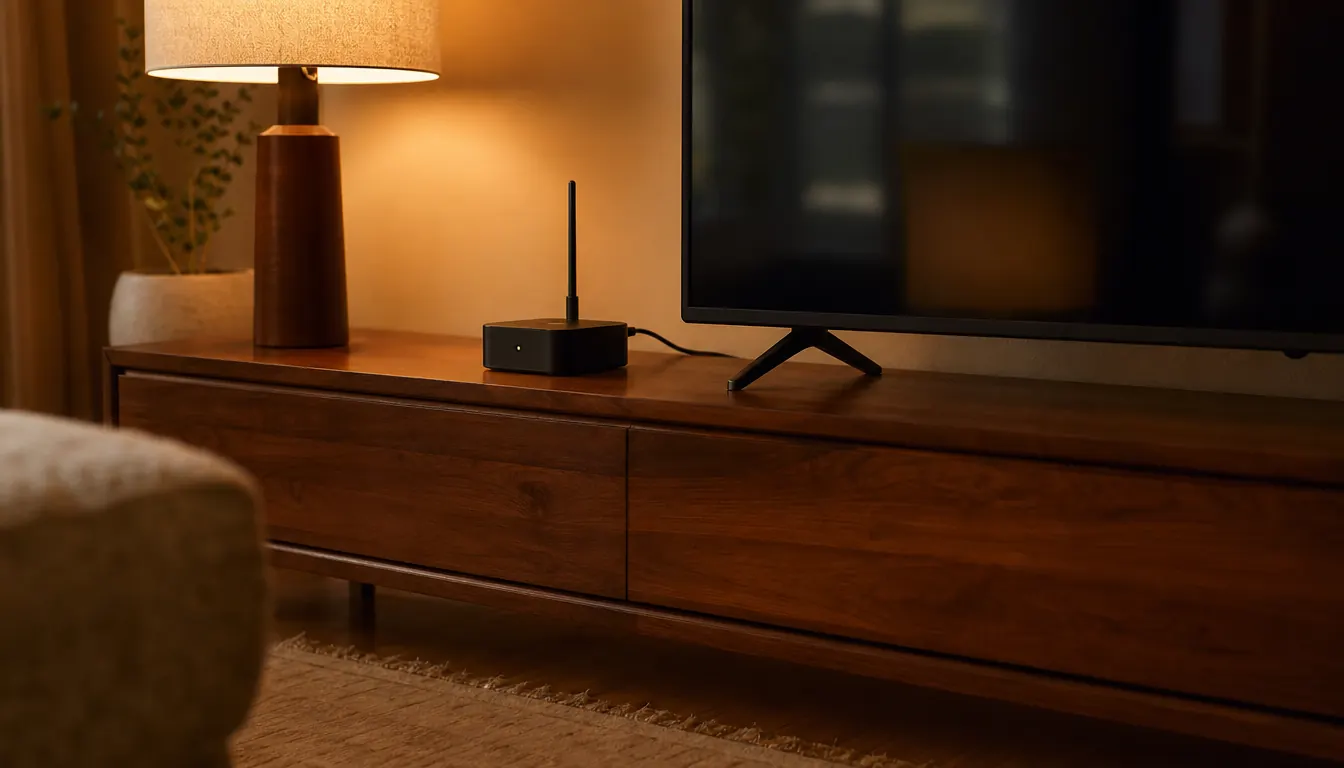
Connect the transmitter to the television with the cable that matches the socket you found in step one, then give the transmitter power from a USB port or a wall adapter. Set it on the low cabinet beside the television rather than behind it. Bluetooth is a polite guest and will not shout through a wall, a cabinet door or a person, so keep the front of the transmitter facing the sofa where you sit. Ours sits about ten feet from my end of the sofa with nothing between them but air.
One more thing about placement. If your television is in a cabinet with a closed door, or the transmitter ends up flat against the wall, expect the sound to stutter when you turn your head. Mine did, once, when I tucked it behind a photograph frame to hide the cable. Moving it four inches fixed it. That is the entire troubleshooting story, and I am happy to have such a short one.
Step 3: Pair the neckband and tell the television where to send the sound
Switch the neckband on and let it find the transmitter. Mine connected on the first attempt, and pairing on later evenings has been a matter of switching both on and waiting a few seconds. If yours does not find it, switch both off, switch the transmitter on first, then the neckband. That order matters more often than the manuals admit, and it is the first thing I try before I start reading a troubleshooting page.
Then tell the television where to send the sound. In the sound menu, look for a setting called Audio Output, Digital Audio Out, or something close to it, and choose the optical or external option rather than the internal speakers. On our set the internal speakers can stay on at the same time, and I have left them on deliberately. Sal hears the room. I hear the neckband. Two people, two volumes, one television, and nobody has to negotiate.
The first thing I heard through the neckband was a Buffalo Bills broadcast, and I heard the crowd noise underneath the commentary for the first time in years. That sounds like a small thing to write down. It was not a small thing to experience. I sat there for a minute with my hand on the band, the way you do when you are checking that something is really working.
Step 4: Fix the lip sync, then set your own volume
Latency is the gap between the picture and the sound, and it is the thing people worry about most before they buy. The Avantree HT4186 is rated under 50 milliseconds with aptX Adaptive, which in practice means I do not see a gap. Fifty milliseconds is a twentieth of a second. I notice it on cooking shows, where a knife hits the board and you hear the thud, and I do not notice it at all on dialogue, which is what I actually watch.
If you do see a gap, look in your television's sound menu for a setting called Audio Delay, Digital Audio Delay or Lip Sync, and nudge it. That adjustment lives in the television, not in the neckband, and it is the correct place to look. The neckband's controls are touch, so there is no dial to hunt for in the dark. I keep a folded note in the drawer with the exact menu path for our set, because I will not remember it in eight months.
Now set your own volume and leave it. The neckband weighs 28 grams, which is about the weight of a folded pair of reading glasses, and I forget I have it on by the second ad break. The earpieces sit in the ear rather than over it, which matters if you wear glasses, and it matters if you have a hearing appointment coming. Sal keeps the room at his level. I keep mine where I need it. Nobody reaches for the remote.
Step 5: Build a charging routine you cannot forget
Both the transmitter and the earbuds charge over Type C, and the published charge time is two hours. Two hours is long enough that you will not do it if you leave it until you are ready for bed, so pick a time earlier in the evening. I plug both in when the six o'clock news starts. By the time the mystery begins, everything is full and I have not thought about it again.
We have a Sunday routine, because our two grandchildren visit on Sundays and the living room becomes a different room. The neckband goes on the charger before they arrive and comes off it after they leave. The cables live in the drawer of the side table, coiled, with the masking tape labels facing up. A routine beats a reminder, in my experience. A reminder is a thing you have to remember to set.
Keep the box and the receipt. The Avantree warranty runs 24 months, and the product registration covers the return shipment cost for the first 12 months. I have never needed it, and I register everything anyway, because I spent three decades watching people discover that the paperwork matters only after something breaks. That is not a technical point. It is just the advice I would give a friend.
Twenty-eight grams on the back of my neck, and Sal has not reached for the volume knob in months.
What Else Helps
Turn the subtitles on and leave them on. I resisted this for a year because it felt like admitting something, and then I noticed that I was reading them less and following more. Subtitles are not a concession. They are a second channel of the same information, and for fast dialogue mixed under music they do work that no volume setting can do. The neckband makes the dialogue louder. The subtitles make it certain.
Get your hearing tested. I am a retired librarian with a neckband, not an audiologist, and I will not pretend to advise anyone about their ears. What I will say is that a professional test told me the shape of my loss, which is why I know that soft voices and fast dialogue are what I lose first, and that background music is what beats me. A neckband is a workaround for the television. It is not a substitute for hearing aids if hearing aids are what you need.
And if you are weighing this against a pair of over-ear television headphones, the honest tradeoff is weight and comfort rather than sound. Over-ear headphones can sound fuller and block the room entirely, which some people want. A neckband leaves your ears open to the room, which means you can hear the doorbell, the oven timer, and a grandchild saying your name. In this house that open ear is the reason the neckband won.
One last piece of advice, and it is the piece I give to everyone who asks. Set the whole thing up on a quiet afternoon rather than ten minutes before a show you want to watch. There is a moment in every setup where something small does not work, and that moment is much easier to solve when nobody is waiting for the programme to start and the clock is not running. I did ours on a Tuesday with a cup of tea and the manual open on the arm of the sofa, and I have not had to think about it since.
A quiet room, and a plot you can follow
The Avantree HT4186 is the kit I would buy again: the Audikast-3 transmitter, the neckband earbuds, both Type C cables, and a rated latency under 50 milliseconds. Check your television's audio output, then check today's price.
Amazon Check Today's Price on Amazon →