
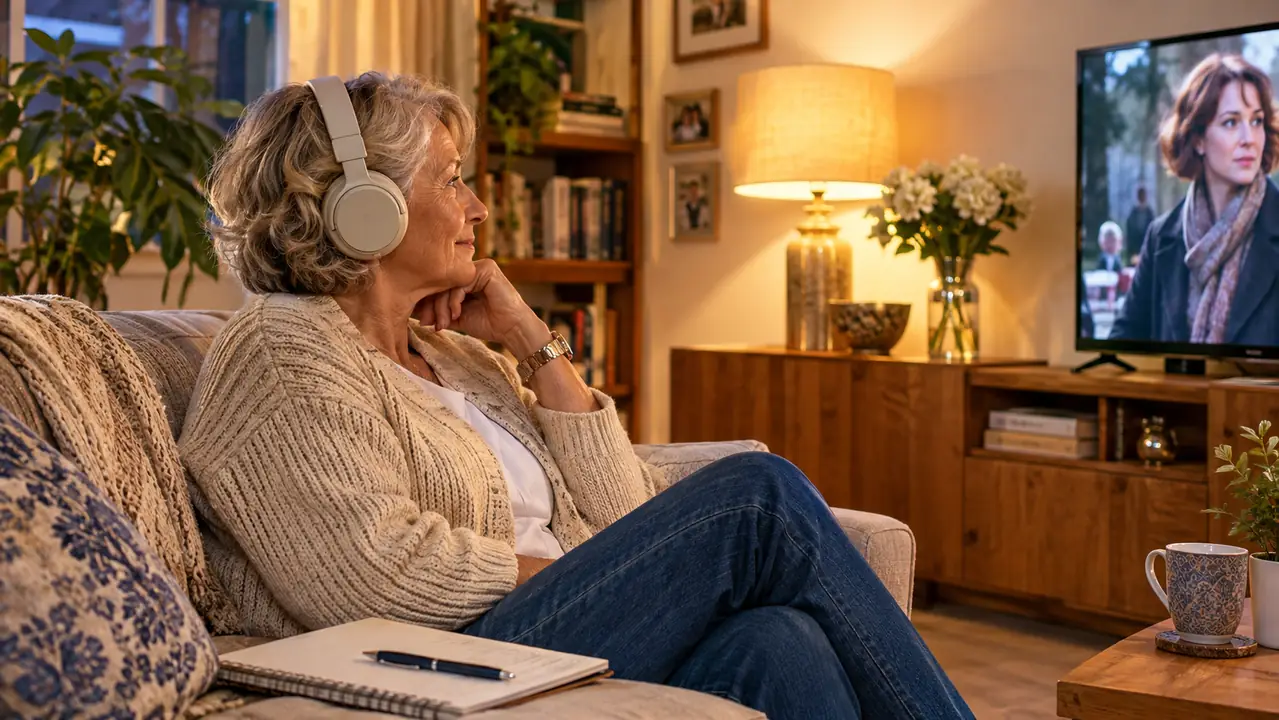
I bought the Avantree HT5009 on a Tuesday afternoon in February, after a British mystery turned into a mumble. Sal was watching beside me with the closed captions on, and I was watching the same screen with my hand cupped behind my ear like a fool. I am 66, a retired middle-school librarian, and I have mild to moderate age-related hearing loss in both ears. I do not wear prescription hearing aids yet. I am not an audiologist. I am simply a person who wanted to follow dialogue without turning the family room into a movie theater for the whole block.
Sal is 68, a retired mail carrier, and his hearing is normal. For years he was the one who winced at the TV volume. I was the one who kept pushing it up. The Avantree HT5009 is a wireless headphone set for TV watching, and it arrived with an adapter that plugs into the TV's audio output. I have now used it for several months, long enough to know what works and what makes me sigh. This is the honest version, including the parts I do not love. I kept notes in a small notebook because that is how I make sense of things.
The Quick Verdict
A clear, comfortable TV headphone set with real range and long playtime, held back by controls that take practice and a fit that warms my ears after two hours.
Amazon Check Today's Price →The dialogue mode is the reason I kept them
If the problem is catching quiet conversation while the rest of the house hears the TV at a normal volume, this is the feature to look at first. Avantree calls it Clear Dialogue Mode. I call it the setting I use every night.
Amazon Check the Avantree HT5009 on Amazon →How I've Used It
I set up the HT5009 in our family room in Rochester, where the 50-inch TV sits on a low cabinet and the sofa is about 10 feet back. The room opens into a small kitchen, which matters later. I read the instructions twice because I am a retired librarian and that is what we do. The transmitter accepts an optical cable, an AUX cable, or RCA cables, and it also works with a TV that has built-in Bluetooth. Our television is not a Bluetooth model, or at least not one I trust, so I used the transmitter with a cable. The manual calls the connection simple, and it was, once I found the right output on the back of the TV.
Before the HT5009 I tried two cheaper things. For most of a year I simply turned the TV up, which worked for me and drove Sal out of the room during mysteries. Then I turned on closed captions for a month. That worked better than the volume, but I spent the whole program reading the bottom of the screen and missing faces, and on a cooking show where the point is the food, reading is a poor substitute for watching. When one of our grandkids visited and set the captions to a font size that covered a quarter of the picture, I decided I wanted a third option.
The first night I wore them for a full episode of a British mystery, the kind where everyone whispers in a vicarage kitchen. I heard the difference before I understood it. The room was quiet, Sal had the TV at a volume he liked, and I had the headphones on. I did not have to ask him to turn it up. That is a small thing unless you have spent three years asking. I wrote one line in my notebook that night: I can hear the quiet parts.
I have since used the HT5009 for cooking shows, Buffalo Bills games, and a Sunday afternoon when our two grandkids visited and the house was louder than the TV. The headphones do not block all room noise, and they are not meant to be earplugs. But they put the dialogue close to my ears, and that is what I needed. I keep a small notebook in the sofa cushion. I wrote down the annoyances too, because a review that only lists the good parts is not useful. A good review should tell you what you will notice on day four, not just day one.
What Clear Dialogue Mode Actually Does
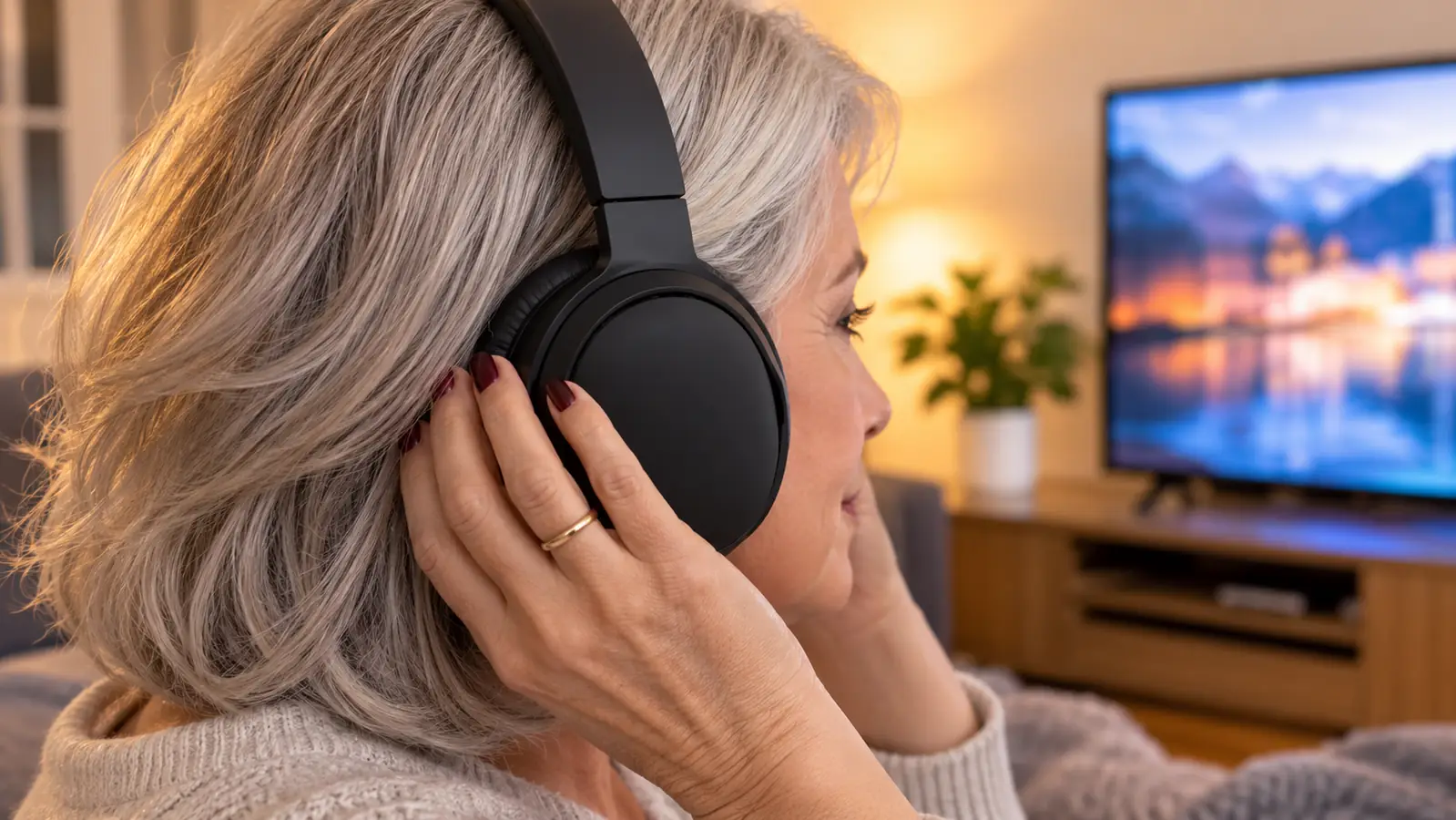
Clear Dialogue Mode is the setting Avantree built this set around, at least for people like me. I cannot tell you the engineering behind it. I can tell you what happens in my family room. When I turn it on, voices come forward and the music and sound effects step back. It is not a volume boost so much as a balance change. On a cooking show, the host's voice stops competing with the stand mixer. On a mystery, the quiet lines around a table become lines I can follow. I use it for every drama now, even the ones with good sound.
The clearest test came on a Tuesday in March. The episode had a long scene in a car with rain on the windshield, and in the past that combination meant I caught every third word and guessed at the rest. With Clear Dialogue Mode on I followed the whole exchange and still heard the rain underneath it. That is the balance I wanted. The weather stayed, and the words came forward.
Enhanced Volume is the other setting I use. I am careful with volume because I do not want to trade one problem for another. I set the TV to a level Sal can hear and use the headphone volume for me. That is the real advantage of a separate headset. The TV stays at a normal level, and I can adjust my own listening without making the room loud. Avantree lists 40 hours of playtime, and I have not run out during a normal week of evening viewing. I charge them on Sunday and they last through the week.
The headphones are over-ear and weigh 196 grams, which is about 6.9 ounces. I looked that up because the first pair of over-ear headphones I owned felt like a vice. These are lighter than that. The ear cups sit around my ears rather than pressing on them. After two hours, the top of my head feels the band, and I take a break. That is my experience, not a defect. If you have a sensitive head, give yourself a short break at the hour mark. The fit is snug enough that I would not wear them for a four-hour movie without a break.
What Annoys Me
The controls are my main complaint. Avantree lists touch control, and in practice that means I sometimes change a setting when I meant to adjust the fit. I have learned to use two fingers and to look at the headphones before I touch them. Sal, who has never met a manual he liked, handed them back to me twice and said they were too fussy. He is not wrong. The controls are not difficult once you know them, but the first week is a practice week. I would not hand these to a grandparent and walk away without a five-minute lesson.
One evening in April I meant to nudge the volume up and instead did something that made the sound go thin and far away. Sal asked from the sofa why the TV had gone strange, and I had to take the headphones off, look at them properly, and start over. It took about a minute to put things right. A minute is not a disaster. But it is the sort of minute that makes a person feel foolish in her own living room, and it is the reason I now set the controls before the program starts rather than during it.
The second annoyance is the one-pair problem. The HT5009 is a headphone set, not a two-person solution. If Sal and I both want to listen closely, one of us is out of luck unless we add a second pair. Most nights that is fine, because he prefers the TV speakers and I prefer the headphones. On a Sunday with the grandkids, I wanted to put a second pair on Sal so we could talk over the game without raising the volume. We could not. That is not a flaw in the sound. It is a limit in the box.
The third is small but real. I have to be deliberate about charging. I plug them in on Sunday, and if I forget, I get a warning tone and a shorter evening. That is on me, not on Avantree, but it is part of living with the set. I would rather write it down than pretend the HT5009 is maintenance-free. The carrying case helps because I keep the headphones in it when I am not using them, and I keep the adapter in the same place. That small habit is the reason I have not lost the adapter in the sofa.
The first night, I followed a whispered scene in a vicarage kitchen without asking Sal to turn up the TV. That was the whole argument for keeping the Avantree HT5009.
Range, Delay, and the Rest of the House
Avantree lists a range of 164 feet. Our family room is about 10 feet from the sofa to the TV, so that number is more than I need inside the room. I did the kettle test on a weeknight, walking from the sofa through the doorway into the kitchen and back. Call it twenty steps each way. The sound never wavered, not at the counter and not at the sink. I have also carried them to the front hall to answer the door in the middle of a game, and the audio held until I reached the stairs. I did not walk out to the yard in February to prove a point about the full figure.
The no audio delay claim matters for sports and lip-sync. I watched a Bills game and a cooking show where the host's mouth moves fast. I did not notice a lag between the picture and the sound. That is the kind of thing I would notice, because I have watched enough bad hotel TVs to know what delay feels like. The HT5009 stayed in step. If you have ever watched a game where the crowd cheers before the ball is snapped, you know why this matters.
Pass-through support is the feature I did not know I wanted. It lets the TV speakers keep working while I use the headphones, so Sal can hear the game at his volume and I can hear it at mine. That sounds simple. It is the difference between a shared room and two people arguing about a number on the screen. I use pass-through every night now. It is also the reason I stopped feeling like the headphones were something I put on to shut Sal out. They are something I put on so we can both stay in the room.

What I Tell Friends Who Ask
A neighbor asked me about the HT5009 after she saw me carrying the case to the sofa. Her situation is the mirror of mine: she hears fine and her husband does not. I told her the truth, which is that it is the first TV listener I have used that made dialogue feel close without making the room loud. I also told her to buy it for the dialogue mode, not for the promise of perfect hearing. It is a headphone set. It does not replace a hearing aid, and it does not sort out every muddy soundtrack. If your problem is that the TV is too quiet for one person and too loud for the other, this is the right shape of solution.
I told her to give herself a week with the controls and to keep the manual in the case. I told her to set the TV at the volume her husband likes and use the headphones for her own level. That is the whole trick. The HT5009 does not make the room quieter. It gives you your own volume. For me, that was worth the practice. For someone who wants a one-button fix with no learning curve, I would say look at a simpler set and accept fewer features. Avantree also lists a 24-month warranty, which I have not needed, but I like knowing it is there. Honest enough.
What I Liked
- Clear Dialogue Mode pulls quiet conversation forward without making the whole room louder
- 40 hours of playtime means I charge once a week, not every night
- 164 feet of range covers the family room and the kitchen
- Optical, AUX, RCA, and built-in Bluetooth options cover most TVs
- Pass-through support lets Sal use the TV speakers while I use the headphones
- At 196 grams, the over-ear fit is light enough for a full episode
Where It Falls Short
- The controls take a week of practice and I still touch them by accident
- One pair only, so two people cannot listen closely without a second set
- I have to remember to charge on Sunday or I get a warning tone mid-show
- The ear cups warm my ears after about two hours and I need a break
- No hearing aid replacement, so it will not fix every listening situation
Who This Is For
This is for the person who can hear the TV when it is loud but loses the words when it is normal. That was me. It is also for couples who have different volume needs, because pass-through support lets one person use the TV speakers while the other uses the headphones. If you want to follow British mysteries, cooking shows, or a football broadcast without asking someone to turn it up every ten minutes, the HT5009 is aimed at you. I would still say this: if you have not had a hearing test in the last few years, get one. A headphone set can make the TV clearer. It cannot tell you what is happening in your ears.
I am not an audiologist, and I am not going to pretend the HT5009 is a medical device. It is a listening tool. It helped me in one specific room, with one specific husband, at one specific volume. That is a narrow kind of proof, but it is the kind I trust. If your room and your ears are similar to mine, it is a reasonable place to start.
Who Should Skip It
Skip it if you want a hearing aid. The HT5009 is a headphone set, and it will not replace a properly fitted device. If your hearing changed suddenly, if you have pain or one-sided loss, or if you have not been evaluated in years, see a professional before you buy any TV listener. That is not a disclaimer I am adding to be safe. It is what I would tell a friend at my kitchen table. I waited too long to get my own hearing checked, and I wish I had gone sooner.
Skip it if you want a one-button solution with no learning curve. The touch controls took me a week, and I am a person who reads manuals. Skip it if two people in the house both need headphones at the same time, unless you plan to add a second pair. And skip it if you expect the headphones to erase all background noise. They do not. They bring dialogue closer. That is a different promise, and it is the one Avantree actually keeps.
If quiet dialogue is the nightly problem, start here
The Avantree HT5009 has stayed on my sofa for months because the dialogue mode and the pass-through support solve the argument Sal and I used to have every night. Read the manual, give the controls a week, and keep a Sunday charging habit.
Amazon See the Avantree HT5009 on Amazon →